MCQ
Relationship between above pair $(A)$ and $(B)$ is
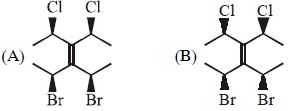
  • A
    Enantiomer
  • Diastereomers
  • C
    Identical
  • D
    Structural isomer

Answer

Correct option: B.
Diastereomers
b

Need a full question paper?

Generate a complete, print-ready paper with questions like this in minutes — across 16+ boards, with answer keys.

Start Generating Free

Similar questions

The effect of increasing the pressure on the equilibrium $2A + 3B$ $\rightleftharpoons$ $3A + 2B$ is
Only two isomers of monochloro product is possible of
What are reactant $X$ and product $Y$ in the following sequence of reactions ?

Reactant  $ X$    Product   $Y$

${I^ - }(aq.) + MnO_4^ - (aq.)\xrightarrow{{{H^ + }}}X + M{n^{2 + }}(aq.)$

${I^ - }(aq.) + MnO_4^ - (aq.)\xrightarrow[{weakly\,\,O{H^ - }}]{{Neutral\,\,or}}Y + Mn{O_2}$

$MnO_4^ - (aq.) + M{n^{2 + }}(aq.)\xrightarrow{{ZnS{O_4}}}Z + 4{H^ + }$

Products $X,\,Y$ and $Z$ are respectively :

Sugar which does not give reddish brown precipitate with Fehling's reagent is:
The reaction of $K _3\left[ Fe ( CN )_6\right]$ with freshly prepared $FeSO _4$ solution produces a dark blue precipitate called Turnbull's blue. Reaction of $K _4\left[ Fe ( CN )_6\right]$ with the $FeSO _4$ solution in complete absence of air produces a white precipitate $X$, which turns blue in air. Mixing the $FeSO _4$ solution with $NaNO _3$, followed by a slow addition of concentrated $H _2 SO _4$ through the side of the test tube produces a brown ring.

Precipitate $X$ is

$(A)$ $Fe _4\left[ Fe ( CN )_6\right]_3$

$(B)$ $Fe \left[ Fe ( CN )_6\right]$

$(C)$ $K _2 Fe \left[ Fe ( CN )_6\right]$

$(D)$ $KFe \left[ Fe ( CN )_6\right]$

Among the following, the brown ring is due to the formation of

$(A)$ $\left[ Fe ( NO )_2\left( SO _4\right)_2\right]^{2-}$

$(B)$ $\left[ Fe ( NO )_2\left( H _2 O \right)_4\right]^{3+}$

$(C)$ $\left[ Fe ( NO )_4\left( SO _4\right)_2\right]$

$(D)$ $\left[ Fe ( NO )\left( H _2 O \right)_5\right]^{2+}$

$17.0\, g$ of $NH _{3}$ completely vapourises at $-33.42^{\circ} C$ and $1\, bar$ pressure and the enthalpy change in the process is $23.4 \,k\,J\, mol ^{-1}$. The enthalpy change for the vapourisation of $85 g$ of $NH _{3}$ under the same conditions is $.....\, kJ .$
Which of the following has maximum boiling point
Which one of the following sketch is not correctly matched ?
Hydrogen can be put in halogen group because