MCQ
Relative rate of reaction with $H_2O$

- A$(i) > (ii) > (iii)$
- B$(ii) > (i) > (iii)$
- ✓$(iii) > (ii ) > (i)$
- D$(iii) > (i) > (ii)$
Generate a complete, print-ready paper with questions like this in minutes — across 16+ boards, with answer keys.
$\begin{array}{*{20}{c}}
{\,\,\,\,H} \\
{\,\,\,\,|} \\
{C{H_3} - C = C - COOH} \\
{|\,\,\,\,\,\,\,\,\,\,\,\,\,\,\,\,\,} \\
{C{H_3}\,\,\,\,\,\,\,\,\,\,\,\,\,}
\end{array}$
$(A)$ $B$ $(B)$ $B _2 H _6$ $(C)$ $B _2 O _3$ $(D)$ $HBF _4$
(Molar mass of $Ca(OH)_2, Na_2SO_4$ and $CaSO_4$ are $74, 143$ and $136\, g\, mol^{-1}$ respectively; $K_{sp}$ of $Ca(OH)_2$ is $5.5 \times 10^{-6}$)
A current was passed for $10$ hours. $10.8\ g\ Ag$ was deposited at cathode in $(III)$ electrolytic cell during electrolysis if current efficiency is $50\%.$
What is magnitude of the current in ampere ?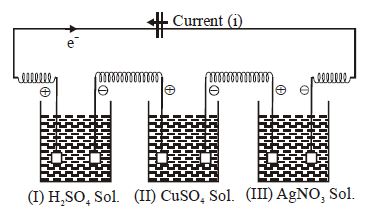
The Gibbs free energy change for the above reaction at $298\, K$ is $x \times 10^{-1} \,k\,J\, mol ^{-1}$;
The value of $x$ is ..... [nearest integer]$\left [\text { Given : } E _{ Cu ^{2} / / Cu }=0.34\, V ; E _{ Sn ^{2} / Sn }^{\ominus}=-0.14 \,V ; F=96500\, C\, mol ^{-1}\right]$