Question
Remainder when $64^{32^{12}}$ is divided by $9$ is equal to $...........$

Answer

Let $32^{32}= t$
$64^{32^{12}}=64^t$
$=8^{2 t}$
$=(9-1)^{2 t}$
$=9 k+1$
Hence remainder $=1$

Need a full question paper?

Generate a complete, print-ready paper with questions like this in minutes — across 16+ boards, with answer keys.
Start Generating Free

Similar questions

The number of $4$ digit numbers that can be formed from the digits $0, \,1,\, 2,\, 3,\ ,4,\ ,5,\, 6,\, 7$ so that each number contain digit $1$ is
If the system of linear equations  $2 x + y - z =7$ ; $x-3 y+2 z=1$  ; $x +4 y +\delta z = k$, where $\delta, k \in R$  has infinitely many solutions, then $\delta+ k$ is equal to
If $S=\{a \in R:|2 a-1|=3[a]+2\{a\}\},$ where [t] denotes the greatest integer less than or equal to $t$ and $\{t\}$ represents the fractional part of $t,$ then $72 \sum_{ a \in S } a$ is equal to $...........$
A software company sets up $m$ number of computer systems to finish an assignment in $17$ days. If $4$ computer systems crashed on the start of the second day, $4$ more computer systems crashed on the start of the third day and so on, then it took $8$ more days to finish the assignment. The value of $m$ is equal to :
If the number of words, with or without meaning, which can be made using all the letters of the word $MATHEMATICS$ in which $C$ and $S$ do not come together, is $(6 !) k$, then $k$ is equal to $............$.
Let $P$ be a point in the first octant, whose image $Q$ in the plane $x+y=3$ (that is, the line segment $P Q$ is perpendicular to the plane $x+y=3$ and the mid-point of $P Q$ lies in the plane $x+y=3$ ) lies on the $z$-axis. Let the distance of $P$ from the $x$-axis be $5$ . If $R$ is the image of $P$ in the xy-plane, then the length of $P R$ is. . . . . .
If focus divides a focal chord of the parabola $y^2 = 16x$ into $2$  parts having lengths $a$ and $c$ , such that $a$ , $b$ , $c$ are in $H.P.$ , then value of $b$ is equal to 
Let $z$ be those complex numbers which satisfy $|z+5| \leq 4$ and $z(1+i)+\bar{z}(1-i) \geq-10, i=\sqrt{-1}$ If the maximum value of $Iz +\left.1\right|^{2}$ is $\alpha+\beta \sqrt{2}$, then the value of $(\alpha+\beta)$ is ...... .
$P(2,1),\,Q(4, - 1),\,R(3,2)$ are the vertices of triangle and if through $P$ and $R$ lines parallel to opposite sides are drawn to intersect in $S$, then the area of $PQRS$ is
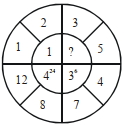
The missing value in the following figure is