Question
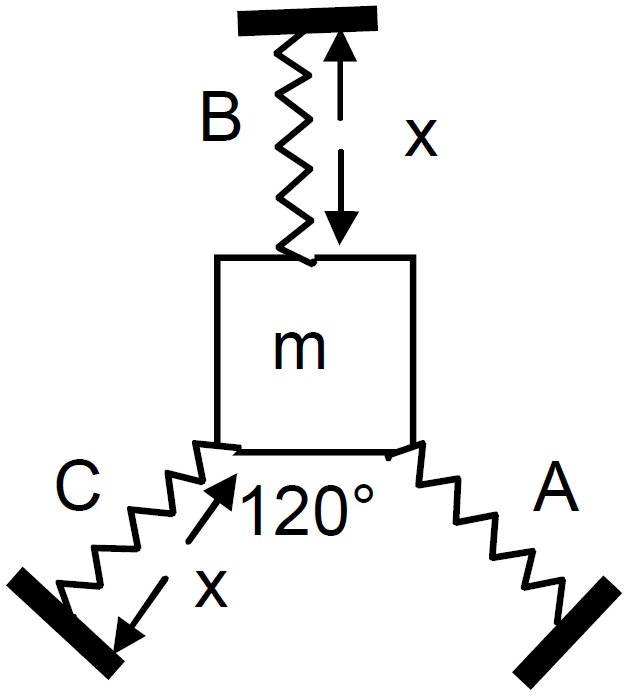
Repeat the previous exercise if the angle between each pair of springs is 120° initially.

Answer

In this case, if the particle ‘m’ is pushed against ’C’ a by distance ‘x’.

Total resultant force acting on man ‘m’ is given by,

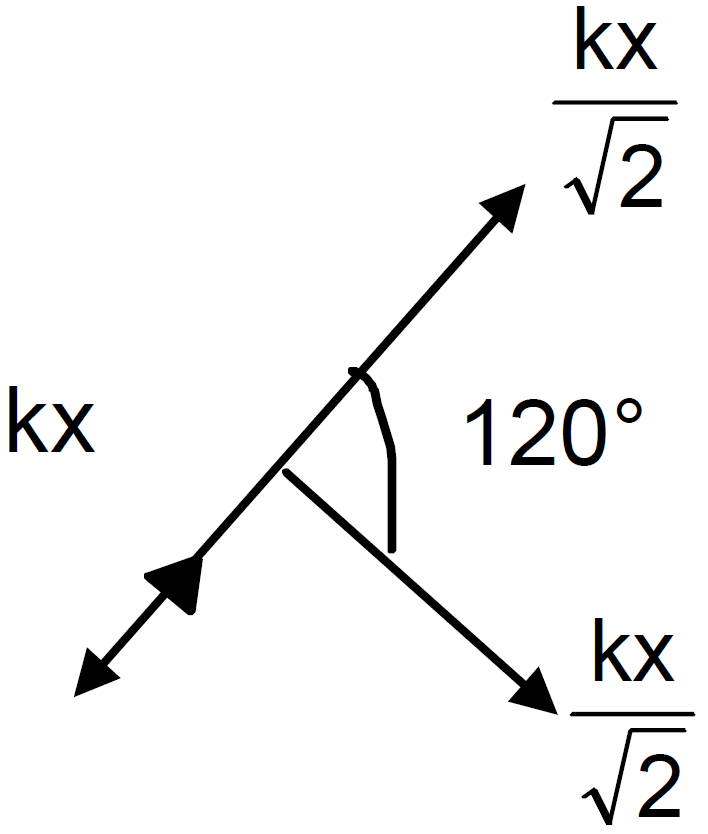
$\text{F}=\text{kx}+\frac{\text{kx}}{2}=\frac{3\text{kx}}{2}$

Because net force $\text{A }\&\text{ B}=\sqrt{\Big(\frac{\text{kx}}{2}\Big)^2+\Big(\frac{\text{kx}}{2}\Big)^2+2\Big(\frac{\text{kx}}{2}\Big)\Big(\frac{\text{kx}}{2}\Big)\cos120^\circ}=\frac{\text{kx}}{2}$

$\therefore\text{a}=\frac{\text{F}}{\text{m}}=\frac{3\text{kx}}{2\text{m}}$

$\Rightarrow\frac{\text{a}}{\text{x}}=\frac{3\text{k}}{2\text{m}}=\omega^2$

$\Rightarrow\omega=\sqrt{\frac{3\text{k}}{2\text{m}}}$

$\therefore$ time period $\text{T}=\frac{2\pi}{\omega}=2\pi\sqrt{\frac{2\text{m}}{3\text{k}}}$
Need a full question paper?

Generate a complete, print-ready paper with questions like this in minutes — across 16+ boards, with answer keys.

Start Generating Free

Similar questions

A light ray, going through a prism with the angle of prism 60°, is found to deviate by 30°. What limit on the refractive index can be put from these data?
According to Newton's third law each team pulls the opposite team with equal force in a tug of war. Why then one team wins and the other loses?
A wave pulse is travelling on a string with a speed v towards the positive X-axis. The shape of the string at t = 0 is given by $\text{g(x)}=\text{A}\sin\big(\frac{\text{x}}{\text{a}}\big),$ where A and a are constants.
  1. What are the dimensions ot A and a?
  2. Write the equation of the wave for a general time t, if the wave speed is v.
Three point charges +Q, -2Q and -3Q are placed at the vertices of an equilateral triangle ABC of side l.
If these charges are displaced to the mid points A1, B1 and C1 respectively, calculate the amount of work done in shifting the charges to the new locations.
What potential difference should be applied across an X-ray tube to get X-ray of wavelength not less than 0.10nm? What is the maximum energy of a photon of this X-ray in joule?
Consider a head-on collision between two particles of masses m1 and m2. The initial speeds of the particles are u1 and u2 in the same direction. The collision starts 2 at t = 0 and the particles interact for a time interval $\triangle\text{t}.$ During the collision, the speed of the first particle varies as.

$\text{v}(\text{t})=\text{u}_1+\frac{\text{t}}{\triangle\text{t}}(\text{v}_1-\text{u}_1).$

Find the speed of the second particle as a function of time during the collision.

Can we perform Young's double slit experiment with sound waves? To get a reasonable "fringe pattern", what should be the order of separation between the slits? How can the bright fringes and the dark fringes be detected in this case?
Explain the behaviour of non polar molecule and polar molecule in uniform electric field.
  1. Write the functions of three segments of a transistor.
  2. Draw the circuit diagram for studying the input and output characteristics of n-p-n transistor in common emitter configuration. Using the circuit, explain how input, output characteristics are obtained.
A nonconducting sheet of large surface area and thickness d contains uniform charge distribution of density $\rho.$ Find the electric field at a point P inside the plate, at a distance x from the central plane. Draw a qualitative graph of E against x for 0 < x < d.