Question
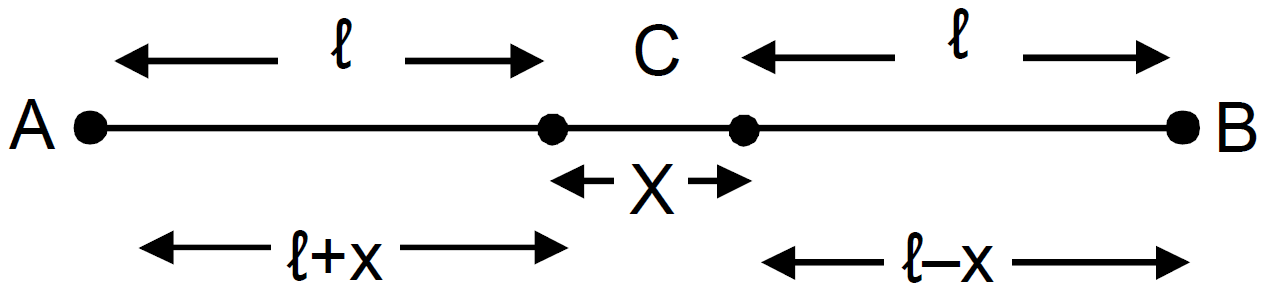
Repeat the previous problem if the particle C is displaced through a distance x along the line AB.
Answer


$\text{F}_\text{AC}=\frac{\text{KQq}}{(\ell+\text{x})^2}$
$\text{F}_\text{CA}=\frac{\text{KQq}}{(\ell-\text{x})^2}$
Net force $=\text{KQq}\Big[\frac{1}{(\ell-\text{x})^2}-\frac{1}{(\ell-\text{x})^2}\Big]$
$=\text{KQq}\bigg[\frac{(\ell+\text{x})^2-(\ell-\text{x})^2}{(\ell+\text{x})^2(\ell-\text{x})^2}\bigg]$
$=\text{KQq}\bigg[\frac{4\ell\text{x}}{(\ell^2-\text{x}^2)^2}\bigg]$
$\text{x}<<<\text{l}=\frac{\text{d}}{2}$ neglecting x w.r.t. $\ell$ We get
net $\text{F}=\frac{\text{KQq}4\ell\text{x}}{\ell^4}=\frac{\text{KQq}4\text{x}}{\ell^3}$ acceleration $=\frac{4\text{KQqx}}{\text{m}\ell^3}$
Time period $=2\pi\sqrt{\frac{\text{displacement}}{\text{acceleration}}}$
$=2\pi\sqrt{\frac{\text{xm}\ell^3}{4\text{KQqx}}}$
$=2\pi\sqrt{\frac{\text{m}\ell^3}{4\text{KQq}}}$
$=\sqrt{\frac{4\pi^2\text{m}\ell^34\pi\in_0}{4\text{Qq}}}$
$=\sqrt{\frac{4\pi^3\text{m}\ell^3\in_0}{\text{Qq}}}$
$=\sqrt{4\pi^3\text{md}^3\in_08\text{Qq}}$
$=\bigg[\frac{\pi^3\text{md}^3\in_0}{2\text{Qq}}\bigg]^{\frac{1}{2}}$

Need a full question paper?

Generate a complete, print-ready paper with questions like this in minutes — across 16+ boards, with answer keys.
Start Generating Free

Similar questions

$(II)$ A compound microscope consists of an objective lens of focal length $2.0 \ cm$ and an eyepiece of focal length $6.25 \ cm$ separated by a distance of $15 \ cm$. How far from the objective should an object be placed in order to obtain the final image at
$(a)$ the least distance of distinct vision $(25 \ cm)$ and
$(b)$ infinity? What is the magnifying power of the microscope in each case?
There are two coils A and B seperated by some distance. If a current of 2A flows through A, a magnetic flux of $10^{-2}$Wb passes through B (no current through B). If no current passes through A and a current of 1A passes through B, what is the flux through A?
A hemispherical portion of the surface of a solid glass sphere $(\mu=1.5)$ of radius r is silvered to make the inner side reflecting. An object is placed on the axis of the hemisphere at a distance 3r from the centre of the sphere. The light from the object is refracted at the unsilvered part, then reflected from the silvered part and again refracted at the unsilvered part. Locate the final image formed.
The half-life of $^{40}K$ is $1.30 \times 10^9y$. A sample of 1.00g of pure KCI gives 160 counts/ s. Calculate the relative abundance of $^{40}K$ (fraction of $^{40}K$ present) in natural potassium.
Derive Snell's law for refraction of light by Huygen's wave theory.
The magnetic field B and the magnetic intensity H in material are found to be 1.6T and 1000A/m reepectively. Calculate the relative permeability $\mu_\text{r}$ and the susceptibility x of the material.
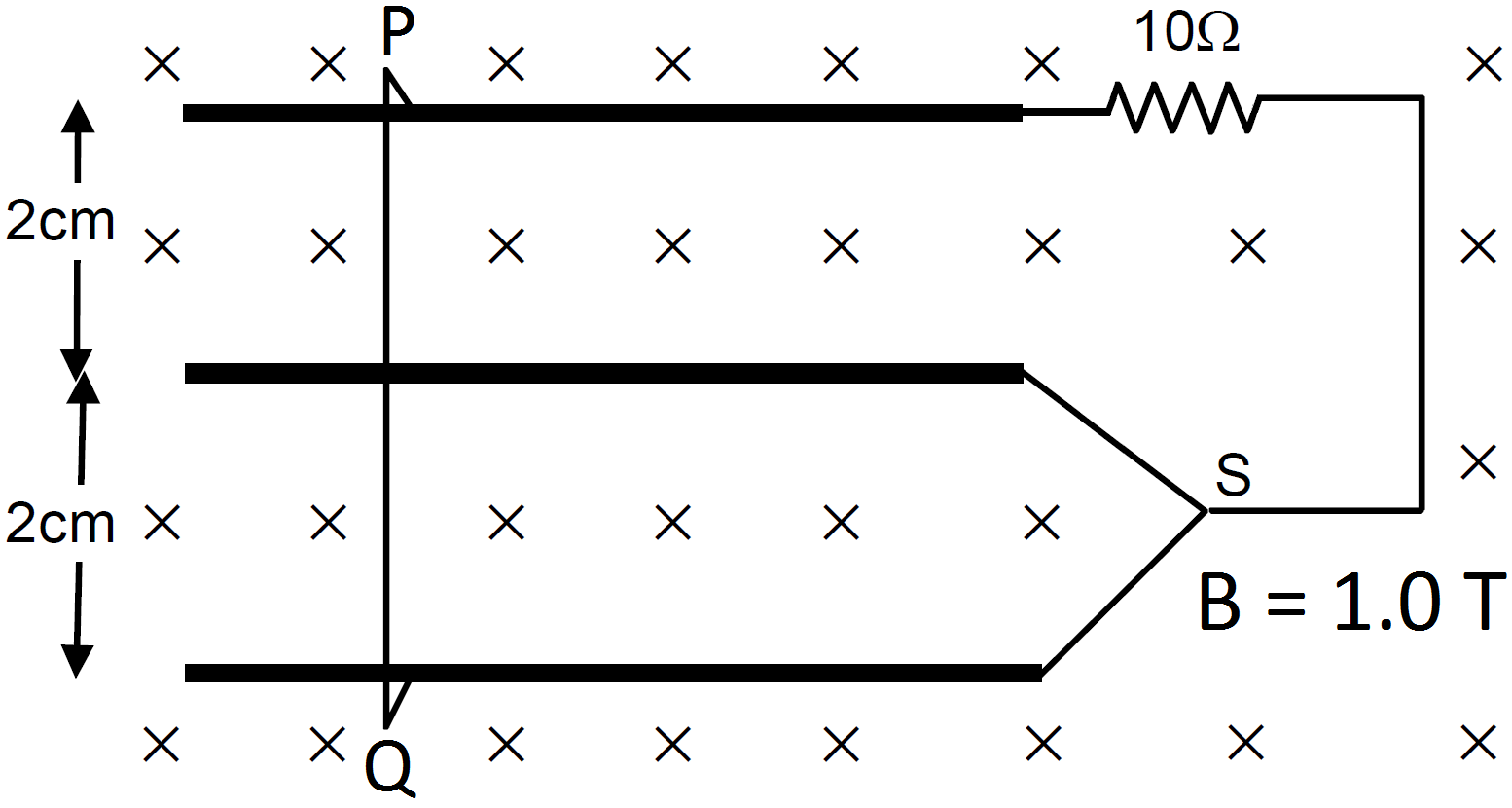
Consider the situation shown in figure. The wire PQ has a negligible resistance and is made to slide on the three rails with a constant speed of 5cm/s. Find the current in the $10\Omega$ resistor when the switch S is thrown to:
  1. The middle rail.
  2. The bottom rail.
Can $\text{L}_\alpha$ X-ray of one material have shorter wavelength than $\text{K}_\alpha$ X-ray of another?
The amount of charge that passes in time t through a cross-section of a wire is,
$Q(t) = At^2 + Bt + C.$​​​​​​​
  1. Write the dimensional formulae for A, B and C.
  2. If the numerical values of A, B and C are 5, 3 and 1, respectively, in S.I units, find the value of the current at t = 5s.
A particle stays at rest as seen in a frame. We can conclude that:
  1. The frame is inertial.
  2. Resultant force on the particle is zero.
  3. The frame may be inertial but the resultant force on the particle is zero.
  4. The frame may be non-inertial but there is a non-zero resultant force.