Question
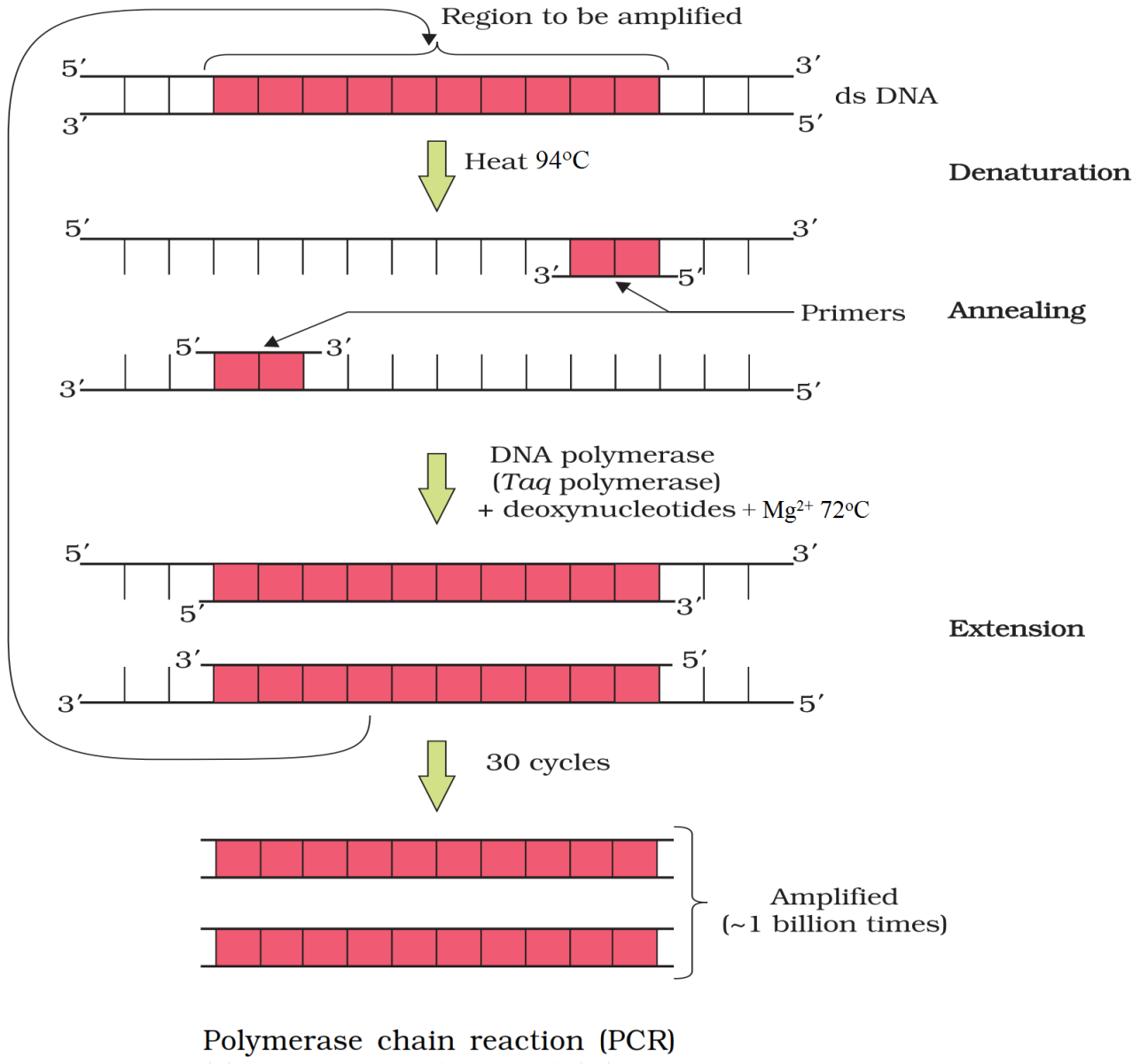
Represent diagrammatically the steps in amplification of a DNA segment. Who designed the process?
Answer


This process was designed by K. Mullis.

Need a full question paper?

Generate a complete, print-ready paper with questions like this in minutes — across 16+ boards, with answer keys.

Start Generating Free

Similar questions

During a visit to Vaishno Devi, Rahul came across a young couple staying in the adjacent room in the hotel. He learnt that the couple had been visiting different temples and performing rituals to get a child. Rahul was astonished and explained to them about ART which he had recently studied in their wrong approach and thanked Rahul.
  1. What is ART? What are the various methods included in ART?
  2. What are the limitations for which ART is not commonly accepted?
  3. Identify the values which Rahul showed.
Answer the following questions:
You are given tall pea plants with yellow seeds whose genotypes are unknown. How would you find the genotype of these plants? Explain with the help of cross.
Samya visited a zoo with her mother, on watching the cheetah, she wondered how he uses his forelimbs for running. While the same forelimbs in bats are used for flying. She wanted to know more about it and so asked her mother (a biology teacher) about it. Her mother explained her how forelimbs are modified in different animal groups for different functions.
  1. What are such organs called?
  2. Give an example of such organs from the plant world.
  3. What led to the origin of such organs?
  4. What are the values shown by Samya?
What are the main divisions of fishery?
What is integrated waste water management? Discuss its advantage.
Thermal pollution.
Erythroblastosis foetalis.
Let us assume in a given plant the genotype symbol $"Y"$ stands for dominant yellow seed colour and " $y$ " for recessive green seed colour; symbol "R" for round seed shape and $" $r$ "$ for wrinkled seeds.
Two homozygous parents (plants) with genotypes $"RRYY"$ and $"rryy"$ are crossed and their $F _{1 \text {-generation progeny }}$ is then selfed. What shall be the:
a. Phenotype of $F _1$-progeny.
b. Genotype of $F _1$-progeny.
c. Gamete genotypes of $F _1$-progeny.
d. Phenotypic ratio of $F _2$ population.
e. Phenotypic ratio of yellow seed to green seed and round seed to wrinkled seed in $F_2$ population.
Answer the following questions:
Name the stages in a human female where:
  1. Corpus luteum and placenta co–exist.
  2. Corpus luteum temporarily ceases to exist.
Central Dogma of molecular biology.