Question
Represent $\sqrt{4.7}$ geometrically on the number line.
Answer

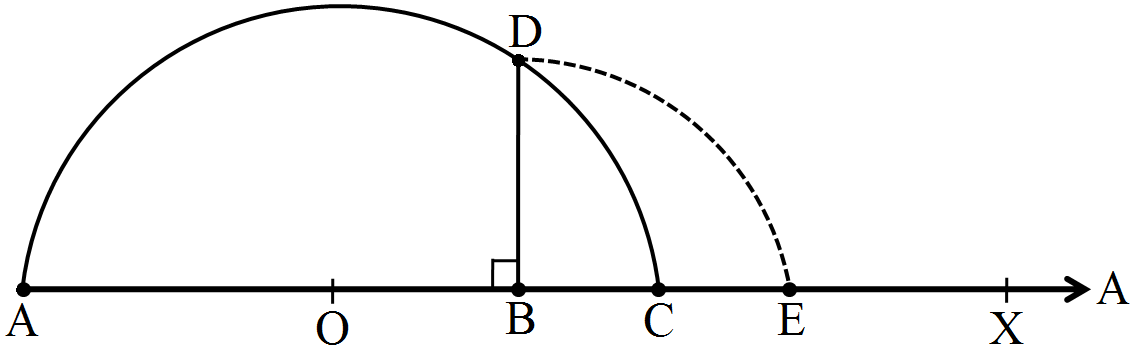
Draw a line segment AB = 4.7 units and extend it to C such that BC = 1 unit.
Find the midpoint O of AC.
With O as centre and OA as radius, draw a semicircle.
Now, draw $\text{BD}\perp\text{AC},$ intersecting the semicircle at D.
Then, $\text{BD}=\sqrt{4.7}\text{units}.$
With B as centre and BD as radius, draw an arc, meeting AC produced at E.

Then, $\text{BE}=\text{BD}=\sqrt{4.7}\ \text{units}.$

Need a full question paper?

Generate a complete, print-ready paper with questions like this in minutes — across 16+ boards, with answer keys.
Start Generating Free

Similar questions

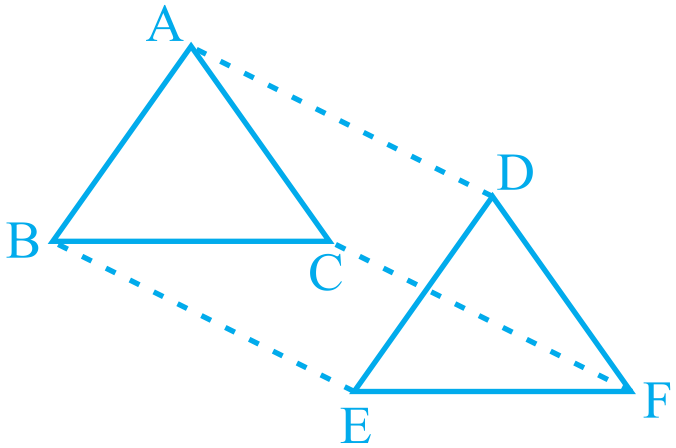
In $\triangle\text{ABC}$ and $\triangle\text{DEF},$ AB = DE, AB || DE, BC = EF and BC || EF. Vertices A, B and C are joined to vertices D, E and F respectively. Show that
  1. Quadrilateral ABED is a parallelogram.
  2. Quadrilateral BEFC is a parallelogram.
  3. AD || CF and AD = CF
  4. quadrilateral ACFD is a parallelogram.
  5. AC = DF
  6. $\triangle\text{ABC}\cong\triangle\text{DEF}.$
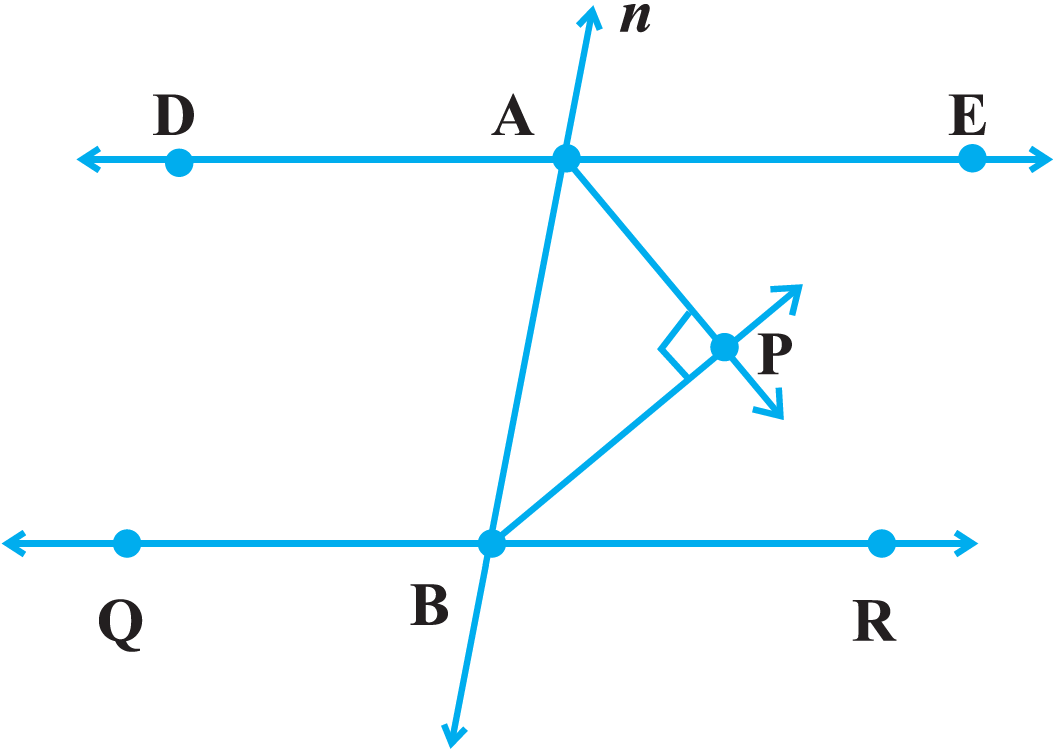
In Fig. $\text{DE}||\text{QR}$ and AP and BP are bisectors of $\angle\text{EAB}$ and respectively. Find $\angle\text{APB}$

Draw the graph of y = |x|.
A cylindrical tube, open at both ends, is made of metal. The internal diameter of the tube is 10.4cm and its length is 25cm. The thickness of the metal is 8mm everywhere. Calculate the volume of the metal.
Draw a histogram to represent the following grouped frequency distribution:
Ages (in years)
Number of teachers
20-24
25-29
30-34
35-39
40-44
45-49
50-54
10
28
32
48
50
35
12
In a quadrilateral ABCD, CO and DO are the bisectors of $\angle\text{C}\ \text{and}\ \angle\text{D}$ respectively. Prove that $\angle\text{COD} = \frac{1}{2} (\angle\text{A}\ \text{and}\ \angle\text{B})$.
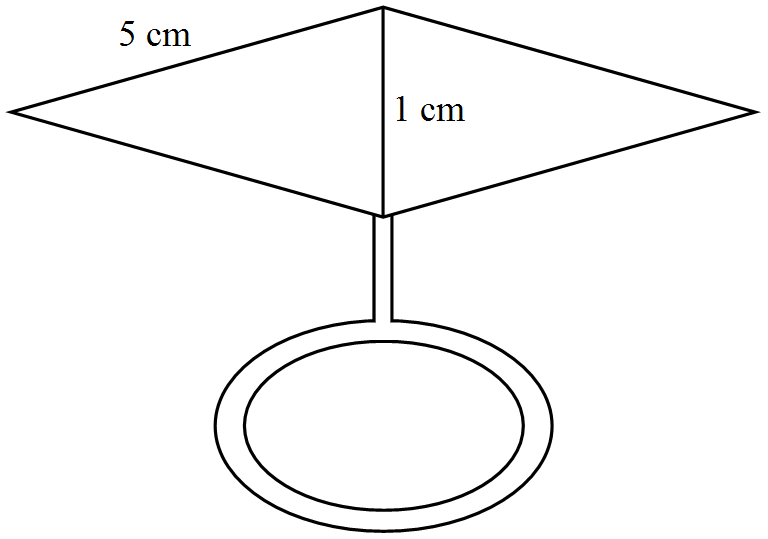
Find the area of the of the blades of the magnetic compass shown in Fig. below
$\big($ Take $\sqrt{11}=3.32\big).$

In a parallelogram ABCD, AB = 10cm and AD = 6cm. The bisector of $\angle\text{A}$meets DC in E. AE and BC produced meet at F. Find the length of CF.
In figure, ABCD is a trapezium in which AB = 7cm, AD = BC = 5cm, DC = x cm, and distance between AB and DC is 4cm. Find the value of x and area of trapezium ABCD.

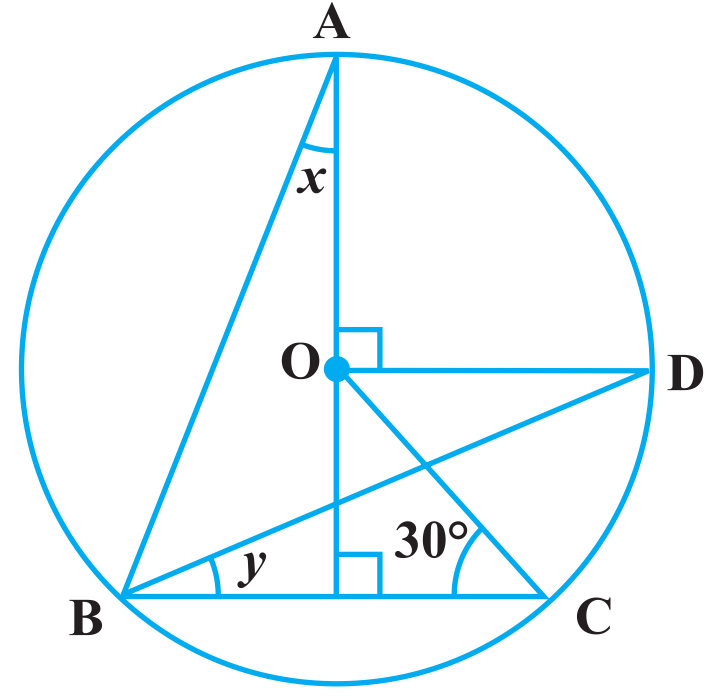
In Fig. O is the centre of the circle, $\angle\text{BCO}=30^\circ.$ Find x and y.