Question
Represent $\sqrt{6},\sqrt{7},\sqrt{8}$ on the number line.
Answer


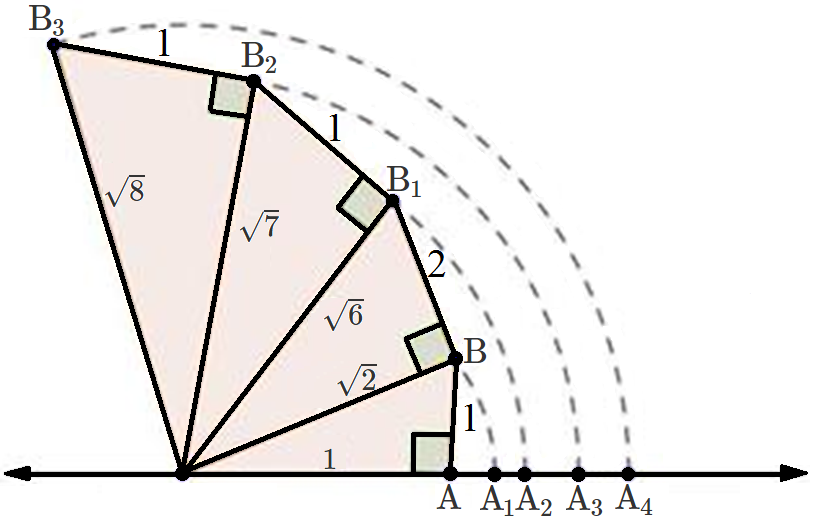
Draw a number line and mark a point $O$, representing zero, on it.
Suppose point A represents $1$ as shown. Then, $O A=1$.
Draw a right triangle $O A B$ such that $A B=O A=1$.
By pythagoras theorem, we have
$(OB)^2 = (OA)^2 +(AB)^2$
$\Rightarrow OB^2 = 1^2 + 1^2 = OB2 = 1 +1 = 2$
$\Rightarrow\text{OB}=\sqrt{2}$
Now, draw a circle with centre $O$ and radius $O B$. We find that the arcle cuts the number line at $A$.
Clearly, $A _1= OB =$ Radius of the cirde $=\sqrt{2}$
Thus, $A_1$ represents $\sqrt{2}$ on the number line.
Now, draw a right triangle $OBB _1$, such that $BB _1=2$.
Again by pythagoras theorem, we have,
$\text{OB}^2_1=\text{OB}^2+\text{BB}^2_1$
$\Rightarrow\text{OB}^2_1=\big(\sqrt{2}\big)^2+(2)^2$
$\Rightarrow\text{OB}^2_1=6$
$\Rightarrow\text{OB}_1=\sqrt{6}$
Now, draw a circle with centre $O$ and radius $OB _1$. We find that the circle cuts the number line at $A _2$.
Clearly, $OA _2= OB _2=$ Radius of circle $=\sqrt{6}$
Thus, $A_2$ represents $\sqrt{6}$ on the number line.
Now, draw a right angle triangle $OB _1 B_2$ such that $B _1 B_2=1$.
By pythagoras theorem, we have,
$\text{OB}^2_2=\text{OB}^2_1+\text{B}_1\text{B}^2_2$
$\Rightarrow\text{OB}^2_2=\big(\sqrt{6}\big)^2+(1)^2$
$\Rightarrow\text{OB}^2_2=6+1=7$
$\Rightarrow\text{OB}_2=\sqrt{7}$
Now, draw a circle with centre $O$ and radius $OB _2$. We find that the circle cuts the number line at $A _3$.
Clearly, $OA _3= OB _2=$ Radius of circle $=\sqrt{7}$
Thus, $A_3$ represents $\sqrt{7}$ on the number line.
Now, again draw a right triangle $OB _2 B_3$ such that $B _2 B_3=1$.
By pythagoras theorem, we have,
$\text{OB}^2_3=\text{OB}^2_2+\text{B}_2\text{B}^2_3$
$\Rightarrow\text{OB}^2_3=\big(\sqrt{7}\big)^2+(1)^2$
$\Rightarrow\text{OB}^2_3=7+1=8$
$\Rightarrow\text{OB}_3=\sqrt{8}$
Now, draw a circle with centre $O$ and radius $OB _3$. We find that the circle cuts the number line at $A _4$.
Clearly, $OA _4= OB _3=$ Radius of circle $=\sqrt{8}$
Thus, $A_4$ represents $\sqrt{8}$ on the number line.

Need a full question paper?

Generate a complete, print-ready paper with questions like this in minutes — across 16+ boards, with answer keys.

Start Generating Free

Similar questions

In a parallelogram $ABCD, AB = 10cm$ and $AD = 6cm.$ The bisector of $\angle\text{A}$meets $DC$ in $E. AE$ and $BC$ produced meet at $F.$ Find the length of $CF.$
Find the value of $p$, if the mean of the following distribution is $20.$
x:
$15$
$17$
$19$
$20 + p$
$23$
f:
$2$
$3$
$4$
$5p$
$6$
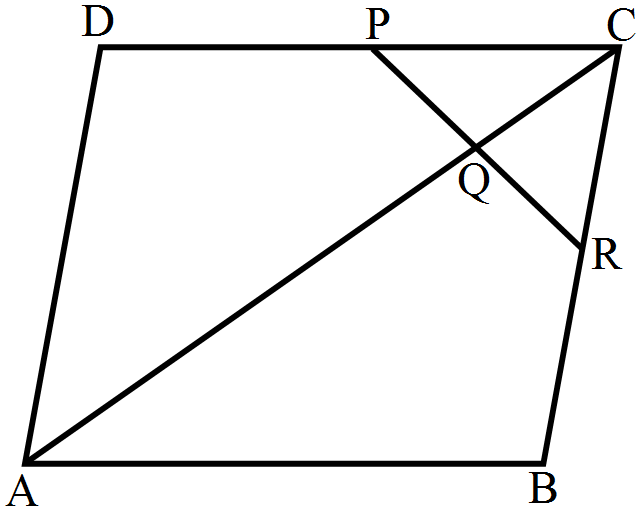
In $ABCD$ is a parallelogram in which $P$ is the mid-points of $DC$ and $Q$ is a point on $AC$ such that $\text{CQ}=\frac{1}{4}\text{AC}.$ if $PQ$ produced meets $BC$ at $E$, prove $R$ is a mid-points of $BC$.
The water bills (in rupees) of $32$ houses in a certain street for the period $1.198$ to $31.398$ are given below: $56, 43, 32, 38, 56, 24, 68, 85, 52, 47, 35, 58, 63, 74, 27, 84, 69, 35, 44, 75, 55, 30, 54, 65, 45, 67, 95, 72, 43, 65, 35, 69.$ Tabulate the data and present the data as a cumulative frequency table using $70 - 79$ as one of the class intervals.
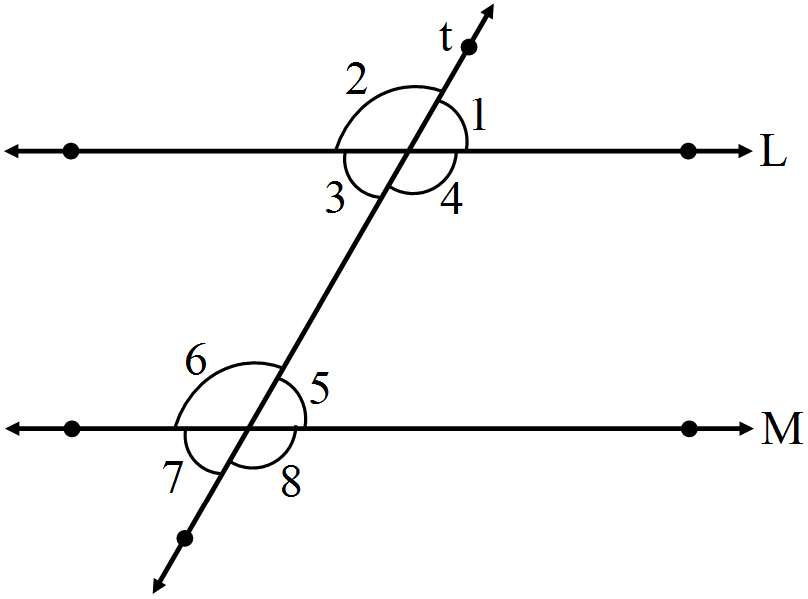
In the given figure, $l || m$ and a transversal $t$ cuts them, If $\angle7=80^\circ,$ find the measure of each of the remaining marked angles.
If $2 x+3 y=13$ and $x y=6$, find the value of $8 x^3+27 y^3$.
ABCD is a rectangle and P, Q, R and S are mid-points of the sides AB, BC, CD and DA respectively. Show that the quadrilateral PQRS is a rhombus.
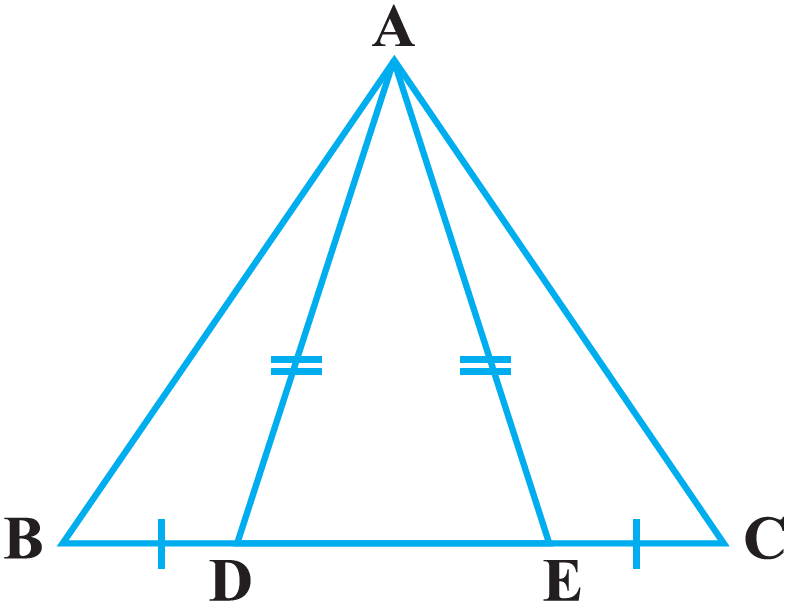
In $D$ and $E$ are points on side $BC$ of a $\triangle\text{ABC}$ such that $BD = CE$ and $AD = AE.$ Show that $\triangle\text{ABC}\cong\triangle\text{ACE}.$
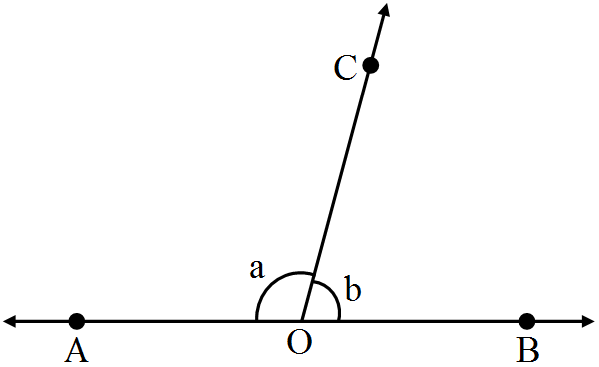
In Figure, if a is greater than b by one third of a right angle. Find the value of $a$ and $b.$