Question
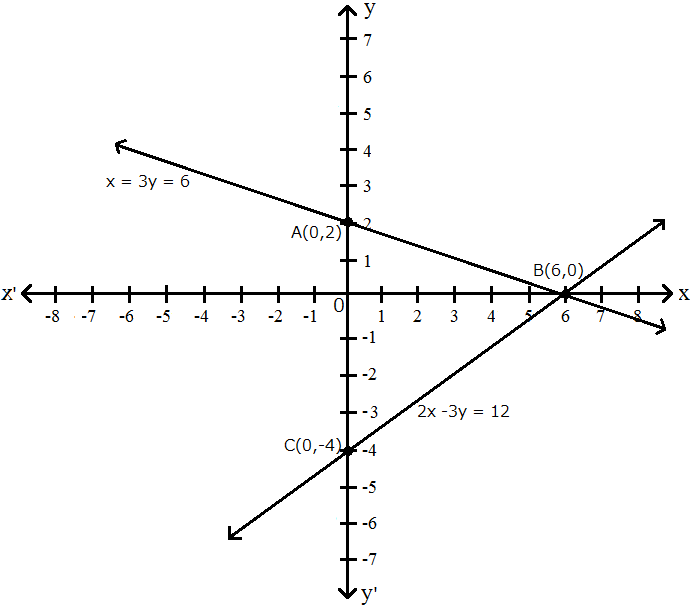
Represent the following pair of equations graphically and write the coordinates of points where the lines intersects y-axis.
x + 3y = 6,
2x - 3y = 12.

Answer

The given equations are
x + 3y = 6 ......(i)
2x - 3y = 12 ........(ii)
Putting x = 0 in equation (i) we get,
⇒ 0 + 3y = 6
⇒ y = 2
⇒ x = 0, y = 2
Putting y = 0 in equation (i) we get,
⇒ x + 3 × 0 = 6
⇒ x = 6
⇒ x = 6, y = 0
Use the following table to draw the graph.
x
0
6
y
2
0
The graph of (i) can be obtained by plotting the two points A(0, 2), B(6, 0).
2x - 3y = 12 ......(ii)
Putting x = 0 in equation (ii) we get,
⇒ 2 × 0 - 3y = 12
⇒ y = -4
⇒ x = 0, y = -4
Putting y = 0 in equation (ii) we get,
⇒ 2x - 3 × 0 = 12
⇒ x = 6
⇒ x = 6, y = 0
Use the following table to draw the graph.
x
0
6
y
-4
0
Draw the graph by plotting two points C(0, -4), D(6, 0) from table.

Graph of lines represented by the equations x + 3y = 6, 2x - 3y = 12 meet y-axis at A(0, 2), C(0, -4) respectively.

Need a full question paper?

Generate a complete, print-ready paper with questions like this in minutes — across 16+ boards, with answer keys.
Start Generating Free

Similar questions

What is the $5^{th}$ term from the end of the AP $2, 7, 12, ...47?$
The sum of first seven terms of an A.P. is $182$. If its $4^{th}$ and the $17^{th}$​​​​​​​ terms are in the ratio $1 : 5$, find the A.P.
Find the sum of all odd numbers between:
$100$ and $200$.
Find the middle term of sequence formed by all three digit numbers which leave a remainder 3 when divided by 4. Also find sum of all numbers on both sides of the middle term.
The sum of the radius of the base and the height of a solid. cylinder is 37 metres. If the total surface area of the cylinder be 1628 sq metres, find its volume.
A solid is in the form of a right circular cylinder, with a hemisphere at one end and a cone at the other end. The radius of the common base is 3.5cm and the heights of the cylindrical and conical portions are 10cm. and 6cm, respectively. Find the total surface area of the solid. $\Big(\text{use}\ \pi=\frac{22}{7}\Big)$
Prove that $\sec ^2 A-\operatorname{cosec}^2 A=\frac{2 \sin ^2 A-1}{\sin ^2 A \cdot \cos ^2 A}$
Solve for x and y:
71x + 37y = 253,
37x + 71y = 287
Radii of the top and the base of a frustum are $14 \mathrm{~cm}, 8 \mathrm{~cm}$ respectively. Its height is $8 \mathrm{~cm}$. Find its
i) curved surface area
ii) total surface area
iii) volume.
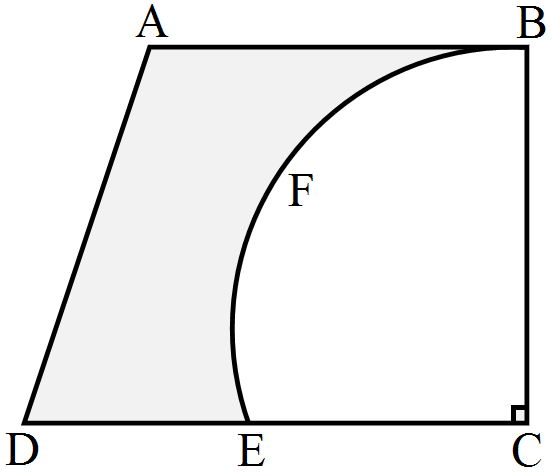
From a thin metallic piece in the shpe of a trapezium ABCD in which $\text{AB}||\text{CD}$ and $\angle\text{BCD}=90^\circ$ a quarter circle BFEC is removed. Given, AB = BC = 3.5cm and DE = 2cm, calculate the area of remaining (shaded) part of metals sheet.