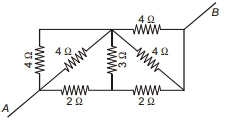
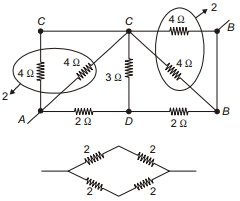
Resistance across $A B$ as shown in figure is ............. $\Omega$
  • A$2$
  • B$4$
  • C$6$
  • D$12$
Medium
art

Download our app
and get started for free

Experience the future of education. Simply download our apps or reach out to us for more information. Let's shape the future of learning together!No signup needed.*

Similar Questions

  • 1
    Two heating coils, one of fine wire and the other of thick wire of the same material and of the same length are connected in series and in parallel. Which of the following statement is correct
    View Solution
  • 2
    the given potentiometer has its wire of resistance $10\, \Omega$. When the sliding contact is in the middle of the potentiometer wire, the potential drop across $2\, \Omega$ resistor is -
    View Solution
  • 3
    The figure shows a tetrahedron, each side of which has a resistance $r$ Choose the correct diagram $(s),$ which show two-dimensional equivalent of the tetrahedron.
    View Solution
  • 4
    Correct set up to verify Ohm's law is
    View Solution
  • 5
    Thirteen resistances each of resistance $R\, ohm$ are connected in the circuit as shown in the figure below. The effective resistance between $A$ and $B$ is
    View Solution
  • 6
    Two identical bulbs are connected in parallel across an ideal source of emf $E$. The ammeter $A$ and voltmeter $V$ are ideal. If bulb $B_2$ gets fused, then
    View Solution
  • 7
    The current flowing through $R _2$ is:
    View Solution
  • 8
    In the circuit shown in the figure, the switch $S$ is initially open and the capacitor is initially uncharged. $ I_1, I_2$ and $I_3$ represent the current in the resistance $2\,\Omega , 4\,\Omega $ and $8\,\Omega$ respectively.
    View Solution
  • 9
    The number density of free electrons in copper is nearly $8 \times 10^{28}\,m ^{-3} . A$ copper wire has its area of cross section $=2 \times 10^{-6}\,m ^2$ and is carrying a current of $3.2\,A$. The drift speed of the electrons is $.....\times 10^{-6}\,ms ^{-1}$.
    View Solution
  • 10
    Three equal resistors connected in series across a source of $e.m.f.$ together dissipate $10\, watt$. If the same resistors are connected in parallel across the same $e.m.f.$, then the power dissipated will be .............. $watt$
    View Solution