MCQ
Resistance of the conductor depends upon:
  • A
    only on the length of the conductor
  • B
    only on the area of cross-section of the conductor
  • C
    only on the substance of the conductor
  • on all of the above

Answer

Correct option: D.
on all of the above
(d)on all of the above

Need a full question paper?

Generate a complete, print-ready paper with questions like this in minutes — across 16+ boards, with answer keys.

Start Generating Free

Similar questions

When ultraviolet rays are incident on metal plate, then photoelectric effect does not occurs. It occurs by the incidence of

(a) X-rays  

(b) Radio wave

(c) Infrared rays

(d) Green house effect

A photon of energy hv is absorbed by o free electron of a metal having work function $\varphi<\text{hv}.$
  1. The electron is sure to come out.
  2. The electron is sure to come out with a kinetic energy $\text{hv}-\varphi.$
  3. Either the electron does not come out or it comes out with a kinetic energy $\text{hv}-\varphi$ .
  4. It may come out with a kinetic energy less than $\text{hv}-\varphi.$
The energy gap in case of which of the following is less than 3eV?
Corpuscles are the tiny particles of:

Assertion  :   If different gases are filled turn by turn at the same pressure in the discharge tube the discharge in them takes place at the same potential.

Reason      : The discharge depends only on the pressure of discharge tube and not on the ionisation potential of gas.

(a) If both assertion and reason are true and the reason is the correct explanation of the assertion.

(b) If both assertion and reason are true but reason is not the correct explanation of the assertion.

(c) If assertion is true but reason is false.

(d) If the assertion and reason both are false.

Current carrying loop of radius $r$ is placed normal to uniform magnetic field $\overrightarrow{ B }$. If current flowing is $I$, then magnetic force acting on it will be __________ .
Two metal spheres of capacitances C1 and C2 carry some charges. They are put in contact and then separated. The final charges Q1 and Q2 on them will satisfy:
  1. $\frac{\text{Q}_1}{\text{Q}_2}<\frac{\text{C}_1}{\text{C}_2}$
  2. $\frac{\text{Q}_1}{\text{Q}_2}=\frac{\text{C}_1}{\text{C}_2}$
  3. $\frac{\text{Q}_1}{\text{Q}_2}>\frac{\text{C}_1}{\text{C}_2}$
  4. $\frac{\text{Q}_1}{\text{Q}_2}=\frac{\text{C}_2}{\text{C}_1}$

The current flowing through a lamp marked as 50 W and 250 V is

(a) 5 amp  

(b) 2.5 amp

(c) 2 amp  

(d) 0.2 amp

A 100 watt bulb working on 200 volt and a 200 watt bulb working on 100 volt have

(a) Resistances in the ratio of 4 : 1

(b) Maximum current ratings in the ratio of 1 : 4

(c) Resistances in the ratio of 2 : 1

(d) Maximum current ratings in the ratio of 1 : 2

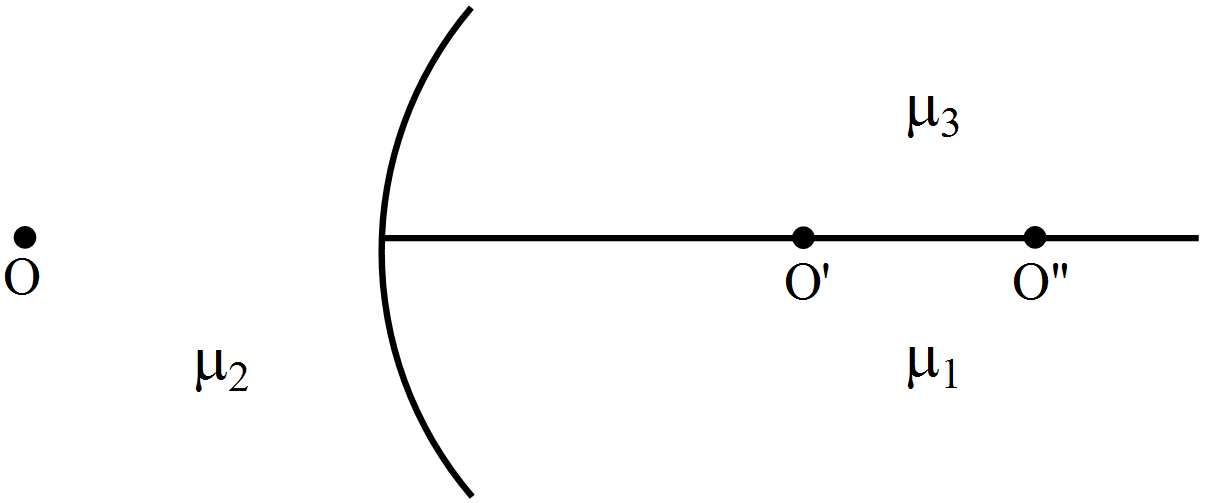
Three transparent media of refractive indices $\mu_1,\mu_2$ and $\mu_3.$ A point object O is placed in the medium $\mu_2.$ If the entire medium on the right of the spherical surface has refractive index $\mu_1,$ the image forms at O'. If this entire medium has refractive index $\mu_3,$ the image forms at O". In the situation shown:
  1. The image forms between O' and O"
  2. The image forms to the left of O'
  3. The image forms to the right of O"
  4. Two images form, one at O' and the other at O".