MCQ
Resistance of the conductor depends upon:
- Aonly on the length of the conductor
- Bonly on the area of cross-section of the conductor
- Conly on the substance of the conductor
- ✓on all of the above
Generate a complete, print-ready paper with questions like this in minutes — across 16+ boards, with answer keys.
It is not convenient to use a spherical Gaussian surface to find the electric field due to an electric dipole using Gauss’s theorem because
|
(a) Gauss’s law fails in this case |
|
(b) This problem does not have spherical symmetry |
|
(c) Coulomb’s law is more fundamental than Gauss’s law |
|
(d) Spherical Gaussian surface will alter the dipole moment |
Energy in the sun is generated mainly by
|
(a) Fusion of radioactive material |
(b) Fission of helium atoms |
|
(c) Chemical reaction |
(d) Fusion of hydrogen atoms |
Which of the following element was discovered by study of Fraunhofer lines
|
(a) Hydrogen |
(b) Oxygen |
(c) Helium |
(d) Ozone |
The bending of light as it passes from one medium into another is commonly known as:
In case of linearly polarized light, the magnitude of the electric field vector :
|
(a) Does not change with time |
|
(b) Varies periodically with time |
|
(c) Increases and decreases linearly with time |
|
(d) Is parallel to the direction of propagation |
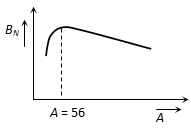
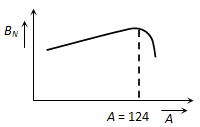
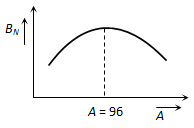
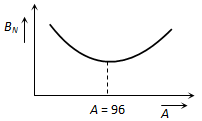
The dependence of binding energy per nucleon,  on the mass number, A, is represented by
|
(a)
|
(b)
|
(C)
|
(d)
|