Resistance of tungsten wire at $150\,^oC$ is $133\,\Omega $. Its resistance temperature coefficient is $0.0045\,^oC$. The resistance of this wire at $500\,^oC$ will be .............. $\Omega$
Medium
Download our app for free and get started
(c) $\frac{{{R_{150}}}}{{{R_{500}}}} = \frac{{[1 + \alpha (150)]}}{{[1 + \alpha (500)]}}$. Putting ${R_{150}} = 133\,\Omega $ and $\alpha = 0.0045\,^o C,$ we get ${R_{500}} = 258\,\Omega $

Download our appand get started for free
Experience the future of education. Simply download our apps or reach out to us for more information. Let's shape the future of learning together!No signup needed.*
Similar Questions
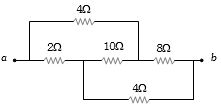
- 1Find the equivalent resistance between the points $a$ and $b$ .......... $\Omega$View Solution
- 2When a current of $2\, A$ flows in a battery from negative to positive terminal, the potential difference across it is $12\, V$. If a current of $3 \,A$ flows in the opposite direction potential difference across the terminals of the battery is $15\, V$, the $emf$ of the battery is ................ $\mathrm{V}$View Solution
- 3A potentiometer wire of length $1\,m$ and resistance $10\,\Omega$ is connected in series with a cell of $emf$ $2\,V$ with internal resistance $1 \,\Omega$ and a resistance box including a resistance $R$. If potential difference between the ends of the wire is $1\, mV$, the value of $R$ is ............. $\Omega $View Solution
- 4View SolutionAssertion : In a simple battery circuit, the point of the lowest potential is negative terminal of the battery.
Reason : The current flows towards the point of the higher potential, as it does in such a circuit from the negative to the positive terminal.
- 5In a potentiometer experiment, it is found that no current passes through the galvanometer when the terminals of the cell are connected across $52\ cm$ of the potentiometer wire. If the cell is shunted by a resistance of $ 5\,\Omega$, a balance is found when the cell is connected across $40\ cm$ of the wire. Find the internal resistance of the cell ........... $\Omega$View Solution
- 6The length of a potentiometer wire is $1200\; \mathrm{cm}$ and it carries a current of $60 \;\mathrm{mA}$. For a cell of $emf\;5\; \mathrm{V}$ and intemal resistance of $20\; \Omega,$ the null point on it is found to be a $1000\; \mathrm{cm} .$ The resistance of whole wire is .............. $\Omega$View Solution
- 7If the length of the filament of a heater is reduced by $10\%$, the power of the heater willView Solution
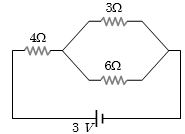
- 8The potential drop across the $3$ $\Omega$ resistor is ............... $V$View Solution
- 9View SolutionThe resistance of a conductor increases with
- 10The length of a potentiometer wire is $l$. $A$ cell of $\mathrm{emf}$ $E$ is balanced at a length $l/3$ from the positive end of the wire. If the length of the wire is increased by $l/2$. At what distance will the same cell give a balance point.View Solution