MCQ
Resolving power of a microscope can $NOT$ be increased by
  • A
    Using "oil immersion objective"
  • B
    Decreasing the wavelength of light used
  • C
    Decreasing the focal length of objective, keeping aperture same.
  • Decreasing the aperture, keeping focal length same.
Answer

Correct option: D.
Decreasing the aperture, keeping focal length same.
d
Resolving power $\propto \frac{a}{\lambda f}$

$a :$ aperture

$\lambda:$ wavelength

$\mathrm{f}:$ focal length

By immersing objective lens in oil, resolving power increases.

Need a full question paper?

Generate a complete, print-ready paper with questions like this in minutes — across 16+ boards, with answer keys.

Start Generating Free

Similar questions

During $\beta^-$ emission:
In the spectrum of hydrogen atom, the ratio of the longest wavelength in Lyman series to the longest wavelength in the Balmer series is
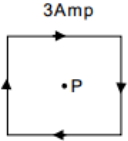
Find magnetic field at centre $P$ if length of side of square loop is $20\, cm$
The de-Broglie wavelength associated with the particle of mass m moving with velocity v is
An electric dipole with dipole moment $\vec p = (3i + 4j) \times 10^{-30} C-m$ is placed in an electric field $\vec E = 4000 \hat i (N/C).$ An external agent turns the dipole slowly until its electric dipole moment becomes $(-4 \hat i + 3 \hat j) ×10^{-30}C-m.$ The work done by the external agent is equal to :-
A battery of $3.0\, V$ is connected to a resistor dissipating $0.5\, W$ of power. If the terminal voltage of the battery is $2.5\, V$ the power dissipated within the internal resistance is$.......W$
A thin lens made of glass of refractive index m = 1.5 has a focal length equal to 12 cm in air. It is now immersed in water $\left(\mu=\frac{4}{3}\right)$. Its new focal length is
A metallic rod oflength '$l$' is tied to a string oflength $2l$. and made to rotate with angular speed w on a horizontal table with one end of the string fixed. Ifthere is a vertical magnetic field '$B$' in the region, the $e.m.f.$ induced across the ends of the rod is
Two positive point charges of 12 μC and 8 μC are 10cm apart. The work done in bringing them 4 cm closer is
A double convex lens has two surfaces of equal radii R and refractive index $\mu=1.5$ We have,