Question
Restriction enzymes are found in bacteria (and other prokaryotes). They recognize and bind to specific sequences of DNA, called restriction sites. Each restriction enzyme recognizes just one or a few restriction sites.
When it finds its target sequence, a restriction enzyme will make a double-stranded cut in the DNA molecule.
i. Write the palindromic nucleotide sequence for the following DNA segment.
5'-GAATTC-3'
ii. Name the restriction endonuclease that recognises this sequence.
iii. How are sticky ends produced? Mention their role.
Answer

i. Palindromic sequence for
5'-GAATTC-3'
3'-CTTAAG-5'
ii. Restriction endonuclease Eco RI recognises the above palindromic sequence.
iii. Sticky ends on DNA are formed by the action of enzymes restriction endonucleases. These enzymes cut the strand of DNA a little away from the centre of the palindrome sequence between the same two bases on both the strands. This results in single- stranded stretches on both the complementary strands at their ends. These overhanging stretches are called sticky ends as they form hydrogen bonds with the complementary basepair sequences.
Role of the sticky ends -These sticky ends produced from hydrogen bonds with their complementary cut counterparts. This stickiness of the ends facilitates the action of the enzyme DNA ligase.

Need a full question paper?

Generate a complete, print-ready paper with questions like this in minutes — across 16+ boards, with answer keys.

Start Generating Free

Similar questions

During her tour to a renowned forest, Sakshi saw a highway being constructed, which passes through the middle of the forest. She was unhappy seeing that and on return, she contacted the local eco-club and approached the concerned department to stop the work.
  1. What would be the effect on biodiversity, if the highway is constructed?
  2. How forests are useful to mankind?
  3. What values of Sakshi reflect here?
Answer the following questions:
State and explain the law of dominance as proposed by Mendel.
Describe various methods of contraception for the population control.###What are the main types of methods of birth control?###Discuss use of Various Contraceptive measures used for population.
What are sexually transmitted diseases? Write the names of these diseases. Also describe the two diseases with special reference on their mode of transmission symptoms and the preventive measures against them.
Let us assume in a given plant the genotype symbol “Y” stands for dominant yellow seed colour and “y” for recessive green seed colour; symbol “R” for round seed shape and “r” for wrinkled seeds.
Two homozygous parents (plants) with genotypes “RRYY” and “rryy” are crossed and their F1–generation progeny is then selfed. What shall be the:
  1. Phenotype of F1–progeny.
  2. Genotype of F1–progeny.
  3. Gamete genotypes of F1–progeny.
  4. Phenotypic ratio of F2 population.
  5. Phenotypic ratio of yellow seed to green seed and round seed to wrinkled seed in F2 population.
A cross was carried out between a pea plant heterozygous for round and yellow seeds with a pea plant having wrinkled and green seeds.
  1. Show the cross in a Punnett square.
  2. Write the phenotype of the progeny of this cross.
  3. What is this cross known as? State the purpose of conducting such a cross.
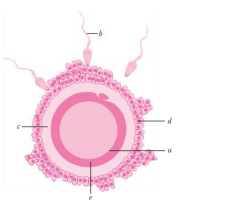
Study the illustration given and answer the questions that follow:

Draw a diagram of ‘b’ separately and label the parts:
  • That help its entry into ‘a’;
  • That carry genetic material;
  • That help in its movement.
  1. State the cause and symptoms of colour-blindness in humans.
  2. Statistical data has shown that 8% of the human males are colour-blind whereas only 0.4% of females are colour-blind. Explain giving reasons how is it so.
How many different types of gametes could result from each of the following genotypes? What will be their genotypes?
  1. Aa.
  2. AABB.
  3. AaBb.
  4. EeCc.
  5. FFIIJj.
Fill in the blanks,
Species A
Species B
Type of Interaction
Example
+
+
+
-
+
_____
_____
_____
Commensalism
_____
_____
_____