Question
✓
Answer
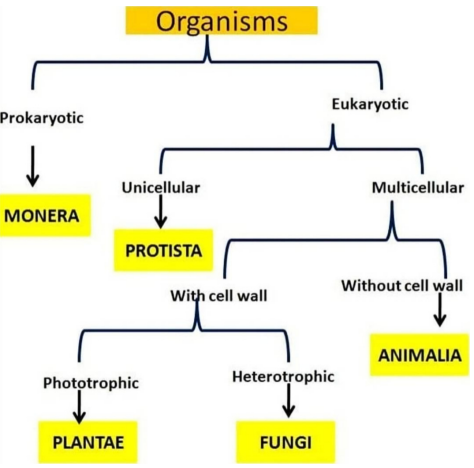
i. All organisms are multicellular, eukaryotes with heterotrophic mode of nutrition.
ii.
iii. Linnaeus used artificial system kingdom of classification.
• Drawbacks of Linnaeus two kingdom classification:
Linnaeus developed a Two Kingdom system of classification with Plantae and Animalia kingdoms.
• This system did not distinguish between eukaryotes and prokaryotes, unicellular and multicellular organisms, photosynthetic (green algae) and non-photosynthetic (fungi) organisms.
OR
No, Fungi-Autotrophic (Photosynthetic) and Heterotrophic is not correct match. The walls of the fungi were made of chitin, whereas the green plants had a cellulose cell wall.
ii.
| Prokaryotic cell | Eukaryotic cell |
| Genetic material is not enclosed in a nuclear envelope and is present suspended in the cytoplasm in a region called nucleoid. | Genetic material is enclosed within the nucleus by a nuclear envelope and is not present in direct contact with cytoplasm. |
| Cell wall is made up of peptidoglycan. | Cell wall is made up of chitin in fungi and cellulose in plants. |
| Nucleolus is absent. | Nucleolus is present. |
• Drawbacks of Linnaeus two kingdom classification:
Linnaeus developed a Two Kingdom system of classification with Plantae and Animalia kingdoms.
• This system did not distinguish between eukaryotes and prokaryotes, unicellular and multicellular organisms, photosynthetic (green algae) and non-photosynthetic (fungi) organisms.
OR
No, Fungi-Autotrophic (Photosynthetic) and Heterotrophic is not correct match. The walls of the fungi were made of chitin, whereas the green plants had a cellulose cell wall.
Need a full question paper?
Generate a complete, print-ready paper with questions like this in minutes — across 16+ boards, with answer keys.
Explore more
Similar questions
Structures of the bacterial ribosome have provided a framework for understanding universal mechanisms of protein synthesis. However, the eukaryotic ribosome is much larger than it is in bacteria, and its activity is fundamentally different in many key ways. All ribosomes are composed of two subunits, both of which are built from RNA and protein. Bacterial ribosomes, for example of Escherichia coli, contain a small subunit (SSU) composed of one 16S ribosomal RNA (rRNA) and 21 ribosomal proteins (r-proteins) and a large subunit (LSU) containing 5S and 23S rRNAs and 33 rproteins. In contrast to their bacterial counterparts, eukaryotic ribosomes are much larger and more complex, containing additional rRNA in the form of so-called expansion segments (ES) as well as many additional r-proteins and r-protein extensions.
(1).Ribosomes are present in
(a) Eukaryotes only
(b) Eukaryotes and prokaryotes
(c) Prokaryotes only
(d) Eukaryotes, prokaryotes and viruses
(2) In 70S ribosomes, ‘S’ stands for
(a) SI unit (b) Solubility factor (c) Svedberg unit (d) all of these
(3) 80 S ribosomes occur in
(a) Eukaryotic cells of animals
(b) Eukaryotic cells of animals and plants
(c) Both Eukaryotic cells and prokaryotic cells
(d) all of these
(4) Ribosomes are made up of
(a) RNA only (b) RNA and proteins (c) RNA, DNA and proteins (d) Nucleic acids, proteins and lipids
(5) Polysomes are
(a) multiple units of ribosomes
(b) attachment of many ribosomes to a common mRNA
(c) attachment of many mRNA to a common ribosome
(d) lysosomal aggregations
(1).Ribosomes are present in
(a) Eukaryotes only
(b) Eukaryotes and prokaryotes
(c) Prokaryotes only
(d) Eukaryotes, prokaryotes and viruses
(2) In 70S ribosomes, ‘S’ stands for
(a) SI unit (b) Solubility factor (c) Svedberg unit (d) all of these
(3) 80 S ribosomes occur in
(a) Eukaryotic cells of animals
(b) Eukaryotic cells of animals and plants
(c) Both Eukaryotic cells and prokaryotic cells
(d) all of these
(4) Ribosomes are made up of
(a) RNA only (b) RNA and proteins (c) RNA, DNA and proteins (d) Nucleic acids, proteins and lipids
(5) Polysomes are
(a) multiple units of ribosomes
(b) attachment of many ribosomes to a common mRNA
(c) attachment of many mRNA to a common ribosome
(d) lysosomal aggregations
Differentiate between male frog and female frog.
Write any four differences between afferent arteriole and efferent arteriole.
Alex used to go to vegetable market with his grandfather, a retired biology teacher. Grandfather told Alex that brinjal, chillies and tomato belong to the same family of plants and asked him to find out the similarity in these plants. Alex found that it's a large family, commonly called as the ' potato family'. Plants belonging to this family are mostly herbs, shrubs and rarely small trees. Many plants belonging to this family are source of food, spice, medicine, fumigatory, and ornamental.
(1).The name of this family is
(a) Solanaceae (b) Fabaceae (c) Liliaceae (d) Brassica ear.
(2). Fruits of this family are known as
(a) Berry or capsule (b) Legume (c) Endosperm (d) Cotyledon.
(3). Aestivation in calyx and corolla of this family is
(a) Valvate (b) Imbricate (c) Twisted (d) Vexillary.
(4). Stamens of the flowers belonging to this family are mostly attached with petals.This condition is known as
(a) Epipetalous (b) Epiphyllous (c) Polyandrous (d) Monoadelphous
(5). Medicinal plants belonging to this family are
(a) Belladonna, Ashwagandha
(b) Aloe, Asparagus
(c) Tobacco, Petunia
(d) Muliathi, Spice.
(1).The name of this family is
(a) Solanaceae (b) Fabaceae (c) Liliaceae (d) Brassica ear.
(2). Fruits of this family are known as
(a) Berry or capsule (b) Legume (c) Endosperm (d) Cotyledon.
(3). Aestivation in calyx and corolla of this family is
(a) Valvate (b) Imbricate (c) Twisted (d) Vexillary.
(4). Stamens of the flowers belonging to this family are mostly attached with petals.This condition is known as
(a) Epipetalous (b) Epiphyllous (c) Polyandrous (d) Monoadelphous
(5). Medicinal plants belonging to this family are
(a) Belladonna, Ashwagandha
(b) Aloe, Asparagus
(c) Tobacco, Petunia
(d) Muliathi, Spice.
Briefly describe any four valves found in the human heart. Make labelled diagram of a cross section of a human heart.
Write the functions of human kidney.
Differentiate between neural control and hormonal control.
Lipids form a heterogeneous group but all are made up of carbon hydrogen and oxygen. These are insoluble in water and soluble in organic solvents like acetone, ether, alcohol etc. The number of oxygen atoms is very small compared to carbon atoms. They need a large amount of oxygen for their oxidation to release energy. They could be simple lipids, compound lipids, and derived lipids. Simple lipids are esters of fatty acid and alcohol. Compound lipids are formed when simple lipids combine with another compounds for example glycolipids, phospholipids and lipoproteins. Derived lipids are of various types and important example being steroids.
(1) Lipids mainly consist of
(a) Carbon only
(b) carbon hydrogen and nitrogen
(c) carbon hydrogen and oxygen
(d) Hydrogen only
(2) Among the given options non-polymeric molecule is
(a) Nucleic acids (b) proteins (c) Lipids (d) polysaccharides
(3) An example of unsaturated fatty acid is
(a) oleic acid (b) stearic acid (c) Linoleic acid (d) both a and c
(4) The number of carbon atoms as compared to oxygen atoms in lipids is
(a) same (b) much less (c) much more (d) none of these.
(5) Steroids are an example of
(a) derived lipids (b) conjugated lipids (c) simple lipids (d) lipo proteins
(1) Lipids mainly consist of
(a) Carbon only
(b) carbon hydrogen and nitrogen
(c) carbon hydrogen and oxygen
(d) Hydrogen only
(2) Among the given options non-polymeric molecule is
(a) Nucleic acids (b) proteins (c) Lipids (d) polysaccharides
(3) An example of unsaturated fatty acid is
(a) oleic acid (b) stearic acid (c) Linoleic acid (d) both a and c
(4) The number of carbon atoms as compared to oxygen atoms in lipids is
(a) same (b) much less (c) much more (d) none of these.
(5) Steroids are an example of
(a) derived lipids (b) conjugated lipids (c) simple lipids (d) lipo proteins