MCQ
Rotational kinetic energy of a given body about an axis is proportional to
  • A
    $Time\ period$
  • B
    $(Time\ period)^2$
  • C
    $(Time\ period)^{-1}$
  • $(time\ period)^{-2}$

Answer

Correct option: D.
$(time\ period)^{-2}$
d

Need a full question paper?

Generate a complete, print-ready paper with questions like this in minutes — across 16+ boards, with answer keys.
Start Generating Free

Similar questions

A standing wave having $3$ nodes and $2$ antinodes is formed between two atoms having a distance $1.21\;\mathring A$ between them. The wavelength of the standing wave is .... $\mathop A\limits^o $
A plane is flying horizontally at $98\, m/s$ and releases an object which reaches the  ground in $10 \sec$. The angle made by object while hitting the ground is   ......... $^o$
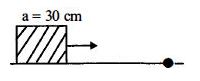
A cubical block of side $30\,cm$  is moving with  velocity $2\,\,ms^{-1}$ on a smooth horizontal surface. The surface has a bump at a point $O$ as shown in figure. The angular velocity (in rad/s) of the block immediately after it hits the bump, is
A glass full of hot milk is poured on the table. It begins to cool gradually. Which of the following is correct?
A block of ice of mass $120\,g$ at temperature $0^{\circ} C$ is put in $300\,gm$ of water at $25^{\circ} C$. The $xg$ of ice melts as the temperature of the water reaches $0^{\circ} C$. The value of $x$ is

[Use: Specific heat capacity of water $=4200$

$J\,kg ^{-1} K ^{-1}$, Latent heat of ice $\left.=3.5 \times 10^{5} J\,kg ^{-1}\right]$
If the intermolecular forces vanish away, the volume occupied by the molecules contained in $4.5 \,kg$ water at standard temperature and pressure will be
According to Newton, the viscous force acting between liquid layers of area $A$ and velocity gradient $\Delta v/\Delta z$ is given by $F = - \eta A\frac{{\Delta v}}{{\Delta z}}$ where $\eta $ is constant called coefficient of viscosity. The dimension of $\eta $ are
Reynold's number $(R_e)$ can be defined as:
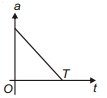
The acceleration (a)-time $(t)$ graph for a particle moving along a straight starting from rest is shown in figure. Which of the following graph is the best representation of variation of its velocity $(v)$ with time $(t)$ ?
A ball dropped from the top of tower falls first half height of tower in $10 \,s$. The total time spend by ball in air is ......... $s$ [Take $g=10 \,m / s ^2$ ]