MCQ
Rutherford’s $\alpha$-particle scattering experiment proved that atom has
- AElectrons
- BNeutron
- ✓Nucleus
- DOrbitals
Generate a complete, print-ready paper with questions like this in minutes — across 16+ boards, with answer keys.
Step $I\,\,:$ ${H_2}O(g)\, \to \,H(g)\, + \,OH(g)\,;$ $\Delta H = 498\,kJ\,mol^{-1}$
Step $II\,\,:$ $OH(g)\, \to \,H(g)\, + \,O(g)\,;$ $\Delta H = 428\,kJ\,mol^{-1}$
The bond enthalpy of the $O-H$ bond is....$kJ\,mol^{-1}$
$A$. $T _4 > T _3 > T _2 > T _1$
$B.$ The black body consists of particles performing simple harmonic motion.
$C.$ The peak of the spectrum shifts to shorter wavelength as temperature increases.
$D.$ $\frac{ T _1}{ v _1}=\frac{ T _2}{ v _2}=\frac{ T _3}{ v _3} \neq$ constant
$E.$ The given spectrum could be explained using quantisation of energy.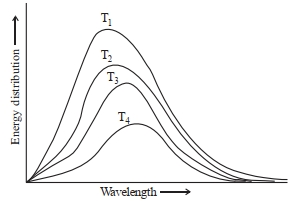
$[ C ]$ is $........$
Statement $I :$ The limiting molar conductivity of $\mathrm{KCl}$ (strong electrolyte) is higher compared to that of $\mathrm{CH}_{3} \mathrm{COOH}$ (weak electrolyte).
Statement $II :$ Molar conductivity decreases with decrease in concentration of electrolyte.
In the light of the above statements, choose the most appropriate answer from the options given below: