MCQ
Rutherford’s $\alpha$-particle scattering experiment proved that atom has
  • A
    Electrons
  • B
    Neutron
  • Nucleus
  • D
    Orbitals

Answer

Correct option: C.
Nucleus
c
(c) According to Rutherford an atom consists of nucleus which is small in size but carries the entire mass $ (P+ N ).$

Need a full question paper?

Generate a complete, print-ready paper with questions like this in minutes — across 16+ boards, with answer keys.

Start Generating Free

Similar questions

$\text{K}_{\text{a}_1},\text{K}_{\text{a}_2}$ and $\text{K}_{\text{a}_3}$ are the respective ionisation constants for the following reactions.
$\text{H}_2\text{S}\rightleftharpoons\text{H}^++\text{HS}^-$
$\text{H}\text{S}^-\rightleftharpoons\text{H}^++\text{S}^{2-}$
$\text{H}_2\text{S}\rightleftharpoons\text{2H}^++\text{S}^{2-}$
The correct relationship between $\text{K}_{\text{a}_1},\text{K}_{\text{a}_2}$ and $\text{K}_{\text{a}_3}$ is
Which of the following reaction satisfy following conditions?

$(a)$ Heat of combustion reaction

$(b)$ Heat of formation reaction

$(c)$ An exothermic reaction

$(d)$ Not neutralization reaction
The number of primary alcohols possible with the formula $C_4H_{10}O$ is :-
Beryllium and magnesium are kinetically inert to oxygen and water because of the formation of :
A sample of pure carbon dioxide, irrespective of its source contains $27.27\%$ carbon and $72.73\%$ oxygen. The data support
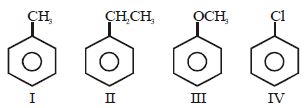
Arrange the following compounds in their correct order of reactivity towards electrophilic substitution reaction
$\begin{array}{*{20}{c}}
  {C{H_3} - C{H_2} - CH - C{H_3}\xrightarrow[{KOH}]{{Alc.}}\mathop X\limits_{\left( {{\text{major}}} \right)} \,;} \\ 
  {\,\,\,\,\,\,\,\,\,\,\,\,|\,\,\,\,\,\,\,\,\,\,\,\,\,\,\,\,\,\,\,\,\,\,\,\,\,\,\,\,\,\,\,} \\ 
  {\,\,\,\,\,\,\,\,\,\,\,\,\,Br\,\,\,\,\,\,\,\,\,\,\,\,\,\,\,\,\,\,\,\,\,\,\,\,\,\,\,\,\,} 
\end{array}\,$

$\begin{array}{*{20}{c}}
  {C{H_3} - C{H_2} - CH - C{H_3}\xrightarrow[\Delta ]{{EtoNa}}\mathop {{\text{ }}Y}\limits_{\left( {{\text{major}}} \right)} } \\ 
  {{\mkern 1mu} {\mkern 1mu} {\mkern 1mu} {\mkern 1mu} {\mkern 1mu} {\mkern 1mu} {\mkern 1mu} {\mkern 1mu} {\mkern 1mu} {\mkern 1mu} {\mkern 1mu} {\mkern 1mu} |{\mkern 1mu} {\mkern 1mu} {\mkern 1mu} {\mkern 1mu} {\mkern 1mu} {\mkern 1mu} \,\,\,\,\,{\mkern 1mu} \,\,\,\,{\mkern 1mu} {\mkern 1mu} {\mkern 1mu} {\mkern 1mu} {\mkern 1mu} {\mkern 1mu} {\mkern 1mu} {\mkern 1mu} {\mkern 1mu} {\mkern 1mu} {\mkern 1mu} {\mkern 1mu} {\mkern 1mu} {\mkern 1mu} {\mkern 1mu} {\mkern 1mu} {\mkern 1mu} {\mkern 1mu} {\mkern 1mu} {\mkern 1mu} {\mkern 1mu} {\mkern 1mu} {\mkern 1mu} {\mkern 1mu} } \\ 
  {{\mkern 1mu} {\mkern 1mu} {\mkern 1mu} \mathop {{\mkern 1mu} {\mkern 1mu} {\mkern 1mu} {\mkern 1mu} \,\,\,\,\,\,\,NM{e_3}\,\,\,\,\,\,\,{\mkern 1mu} }\limits_{\,\,\,\,\,\,\,\,\,\, \oplus \,\,\,\,\,\,\,\,\,\,\,\,\,\,\,\,\,\,\,\,} {\mkern 1mu} {\mkern 1mu} {\mkern 1mu} {\mkern 1mu} {\mkern 1mu} {\mkern 1mu} {\mkern 1mu} {\mkern 1mu} {\mkern 1mu} {\mkern 1mu} {\mkern 1mu} {\mkern 1mu} {\mkern 1mu} {\mkern 1mu} } 
\end{array}{\mkern 1mu} $

Product $(X)$ and $(Y)$ respectively is

What is maximum number of orbitals that can be identified with the following quantum number?
Which of the following is not linear
The orbital angular momentum of $3p$ electron is