MCQ
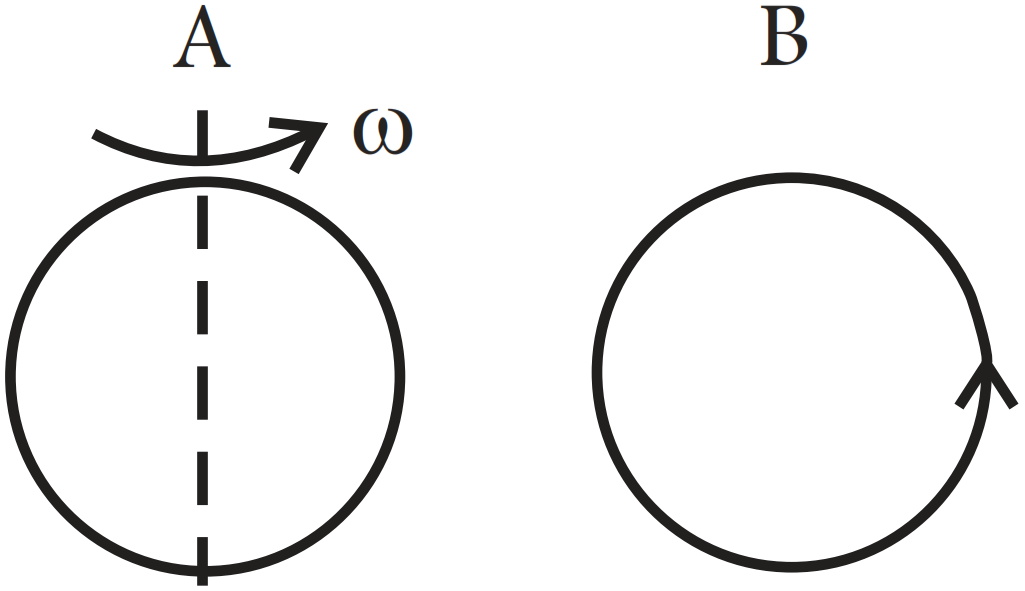
Same as problem $4$ except the coil A is made to rotate about a vertical axis $($Fig$)$. No current flows in $B$ if $A$ is at rest. The current in coil $A$, when the current in $B ($at $t = 0)$ is counterclockwise and the coil $A$ is as shown at this instant, $t = 0$, is:
  • Constant current clockwise.
  • B
    Varying current clockwise.
  • C
    Varying current counterclockwise.
  • D
    Constant current counterclockwise.

Answer

Correct option: A.
Constant current clockwise.

Key concept: In this problem, the Lenz’s law is applicable so let us introduce Lenz’s law first.
Lenz's law gives the direction of induced emf$/$induced current. According to this law, the direction of induced emf or current in a circuit is such as to oppose the cause that produces it. This law is based upon law of conservation of energy.
When the current in coil $B ($at $t = 0)$ is counter-clockwise and the coil $A$ is considered above it. The counter clockwise flow of the current in coil $B$ is equivalent to north pole of magnet and magnetic field lines are eliminating upward to coil $A$. When coil A starts rotating at $t = 0$, the current in $A$ is constant along clockwise direction by Lenz's rule.

Need a full question paper?

Generate a complete, print-ready paper with questions like this in minutes — across 16+ boards, with answer keys.

Start Generating Free

Similar questions

If the mass of neutron is $1.7 \times 10^{-27} \;kg$, then the de-Broglie wavelength of neutron of energy $3\; eV$ is

$\left(h=6.6 \times 10^{34} \;J \cdot sec\right)$,

Which among the following has a relative permeability much larger than $1?$
A radioactive sample at any instant has its disintegration rate 5000 disintegration per minute. After 5 minutes, the rate is 1250 disintegrations per minute. Then, the decay constant (per minute) is
In an $n-p-n$ common emitter ($CE$) transistor the collector current changes from $5\,mA$ to $16\,mA$ for the change in base current from $100\,\mu A$ and $200\,\mu A$, respectively. The current gain of transistor is
Force between two point charges $q_1$ and $q_2$ placed in vacuum at ' $r$ ' $\mathrm{cm}$ apart is $F$. Force between them when placed in a medium having dielectric $\mathrm{K}=5$ at $\mathrm{r} / 5$ $\mathrm{cm}$ apart will be:
The path difference between two interfering waves of equal intensities at a point on the screen is $\frac{\lambda }{4}.$ The ratio of intensity at this point and that at the central fringe will be
A toroid has number of turns per unit length n, current i, then the magnetic field is
How can the brightness of the pattern on the screen or cathode ray tube be changed?
In which radioactive disintegration, neutron dissociates into proton and electron
A foil of aluminium of negligible thickness is inserted in between the space of a parallel plate condenser. If the foil is electrically insulated, the capacity of the condenser will: