MCQ
Same current is flowing through two parallel conducting wires at a distance $d$ in opposite directions. The intensity of magnetic field at the midpoint between the wires is :
  • A
    $\frac{\mu_{ o } i}{2 \pi d}$
  • $\frac{2 \mu_0 i}{\pi d}$
  • C
    $\frac{\mu_0 i}{\pi d^2}$
  • D
    zero

Answer

Correct option: B.
$\frac{2 \mu_0 i}{\pi d}$
(b)$\frac{2 \mu_0 i}{\pi d}$

Need a full question paper?

Generate a complete, print-ready paper with questions like this in minutes — across 16+ boards, with answer keys.

Start Generating Free

Similar questions

Two cells of emf’s approximately 5V and 10V are to be accurately compared using a potentiometer of length 400cm.

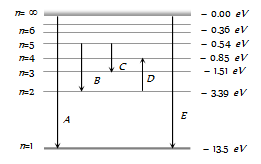
The energy levels of the hydrogen spectrum is shown in figure. There are some transitions A, B, C, D and E. Transition A, B and C respectively represent

(a) First member of Lyman series, third spectral line of Balmer series and the second spectral line of Paschen series

(b) Ionization potential of hydrogen, second spectral line of Balmer series and third spectral line of Paschen series

(c) Series limit of Lyman series, third spectral line of Balmer series and second spectral line of Paschen series

(d) Series limit of Lyman series, second spectral line of Balmer series and third spectral line of Paschen series

Wires P and Q have the same resistance at ordinary (room) temperature. When heated, resistance of P  increases and that of Q decreases. We conclude that

(a) P and Q are conductors of different materials

(b) P is N-type semiconductor and Q is P-type semiconductor

(c) P is semiconductor and Q is conductor

(d) P is conductor and Q is semiconductor

The maximum power drawn out of the cell from a source is given by (where r is internal resistance)

(a)  

(b)  

(c)   

(d)  

A metal conductor of length 1m rotates vertically about one of its ends at angular velocity 5 radians per second. If the horizontal component of earth's magnetic field is 0.2 , then the e.m.f. developed between the two ends of the conductor is

(a) 5mV  

(b) 5  

(c) 50 mV

(d) 50 μV

Which of the following is a unit for intensity of light?

The image distance of an object placed 10 cm in front of a thin lens of focal length + 5 cm is

(a) 6.5 cm

(b) 8.0 cm

(c) 9.5 cm

(d) 10.0 cm

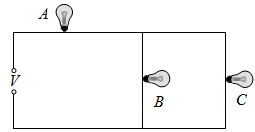
Assertion   : In the given circuit if lamp B or C fuses then light emitted by lamp A decreases.

Reason      : Voltage on A decreases.


(a) If both assertion and reason are true and the reason is the correct explanation of the assertion.

(b) If both assertion and reason are true but reason is not the correct explanation of the assertion.

(c) If assertion is true but reason is false.

(d) If the assertion and reason both are false.

In a laboratory experiment on emission from atomic hydrogen in a discharge tube, only a small number of lines are observed whereas a large number of lines are present in the hydrogen spectrum of a star. This is because in a laboratory:
  1. The amount of hydrogen taken is much smaller than that present in the star.
  2. The temperature of hydrogen is much smaller than that of the star.
  3. The pressure of hydrogen is much smaller than that of the star.
  4. The gravitational pull is much smaller than that in the star.
Two circular loops of equal radii are placed coaxially at some separation. The first is cut and a battery is inserted in between to drive a current in it. The current c~anges slightly because of the variation in resistance with temperature. During this period, the two loops: