Question
Satellite $A$ is in a certain circular orbit about a planet, while satellite $B$ is in a larger circular orbit. Which satellite has $(i)$ the longer period and $(ii)$ the greater speed?

Answer

  1. $\text{T}=2\pi\sqrt{\frac{\text{r}}{\text{GM}}}$
$\therefore$ larger  $'r\ '$,larger $T$
$\therefore$ Satellite B has longer period.
  1. $\text{v}_{\text{o}}=\sqrt{\frac{\text{GM}}{\text{r}}},$ lesser $r, $ more $v_o$
$\therefore$ Satellite $A$ has greater speed.

Need a full question paper?

Generate a complete, print-ready paper with questions like this in minutes — across 16+ boards, with answer keys.
Start Generating Free

Similar questions

A disc of radius 10cm is rotating about its axis at an angular speed of 20rad/s. Find the linear speed of:
  1. A point on the rim.
  2. The middle point of a radius.
A projectile is fired vertically upward from the surface of earth with a speed $kv_e$, where $v_e$. is the escape speed and $k < 1$. Neglecting air resistance show that the maximum height to which it will rise measured from the centre of earth is $\frac{\text{R}}{(1-\text{k}^2)},$ where R is the radius of the earth.
A hydraulic automobile lift is designed to lift cars with a maximum mass of $3000kg$. The area of cross-section of the piston carrying the load is $425cm^2$. What maximum pressure would the smaller piston have to bear?
Equal masses of air are sealed in two vessels, one of volume $V_0$ and the other of volume $2V_0$. If the first vessel is maintained at a temperature 300K and the other at 600K, find the ratio of the pressures in the two vessels.
A particle is projected with a velocity of $40m s^{-1}$. After 2s it just crosses a vertical pole of height $20m$. Calculate the angle of projection and the horizontal range.
Find the temperature at which the average thermal kinetic energy is equal to the energy needed to take a hydrogen atom from its ground state to n = 3 state. Hydrogen can now emit red light of wavelength 653.1nm. Because of Maxwellian distribution of speeds, a hydrogen sample emits red light at temperatures much lower than that obtained from this problem. Assume that hydrogen molecules dissociate into atoms.
A molecule in a gas container hits a horizontal wall with speed $200ms^{-1}$ and angle $30°$ with the normal, and rebounds with the same speed. Is momentum conserved in the collision? Is the collision elastic or inelastic?
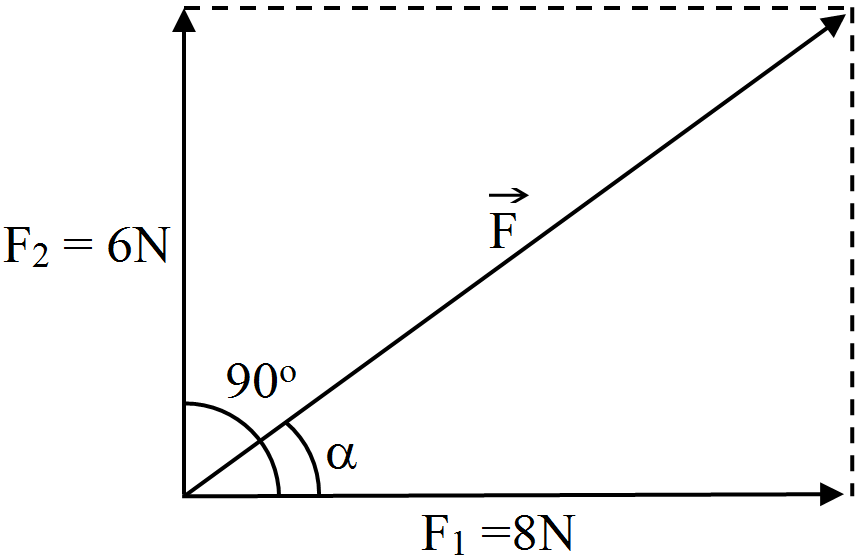
Two mutually perpendicular forces of $8N$ and $6N$ acts on the same body of mass $10\ kg$. Calculate
  1. Net force acting on the body,
  2. Magnitude of the acceleration of the body,
  3. Direction of acceleration of the body.
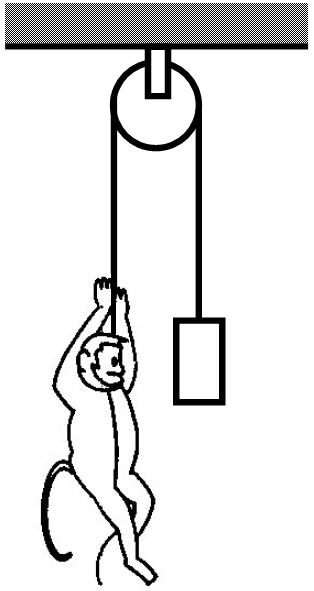
A monkey is climbing on a rope that goes over a smooth light pulley and supports a block of equal mass at the other end figure. Show that whatever force the monkey exerts on the rope, the monkey and the blockmove in the same direction with equal acceleration. If initially both were at rest, their separation will not change as time passes.
If the initial velocity of a particle is u and collinear acceleration at any time t is $\text{a}\propto\text{t}.$ calculate the final velocity of the particle after time t.