MCQ
Schottky defect is observed in the crystal of:
  • A
    $\text{AgCl}$
  • $\text{NaCl}$
  • C
    $\text{MgCl}_2$​
  • D
    $\text{TiCl}$

Answer

Correct option: B.
$\text{NaCl}$
Schottky defect is a type of point defect in crystal lattice named after walter $H$ scottky. In non$-$iodic crystals, it means a lattice vacany defect. In ionic$-$crystals, the defect forms when oppositely charged ions leave their lattice sites, creating vacancies.
Eg$. \text{AgBr, NaCl}.$
$\Rightarrow$ Schottky defect abserved in $\text{NaCl}$ crystal.

Need a full question paper?

Generate a complete, print-ready paper with questions like this in minutes — across 16+ boards, with answer keys.

Start Generating Free

Similar questions

Which one is not an acid salt
Which of the following is most acidic ?
The human body does not produce
Which of the following statements are correct about $Zn,\,Cd$ and $Hg$ ?

$(I)$ they exhibit high enthalpies of atomisation as the $d-$ subshell is full

$(II)$ $zn$ and $Cd$ do not show variable oxidation states while $Hg$ shows $+ I$ and $+ II$

$(III)$ Compound of $Zn,\,Cd$ and $Hg$, are paramagnetic in nature

$(IV)$ $Zn,\,Cd$ and $Hg$ are called soft metals

The set of correct statements is:

$(i)$ Manganese exhibits $+7$ oxidation state in its oxide.

$(ii)$ Ruthenium and Osmium exhibit $+8$ oxidation in their oxides.

$(iii)$ $Sc$ shows $+4$ oxidation state which is oxidizing in nature.

$(iv)$ $Cr$ shows oxidising nature in $+6$ oxidation state.
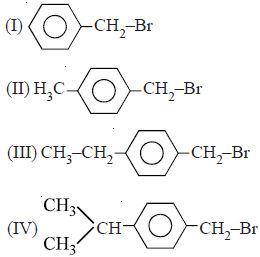
Arrange the following compounds in order of decreasing rate of hydrolysis for $S_{N^{1}}$ reaction :
Compound $A$ is converted to $B$ on reaction with $\mathrm{CHCl}_{3}$ and $\mathrm{KOH}$. The compound $\mathrm{B}$ is toxic and can be decomposed by $C.$ $A, B$ and $C$ respectively are :
The order of basicity among the following compound is
For the metallurgical process of which of the ores calcined ore can be reduced by carbon?
$a.$ Haematite.
$b.$ Calamine.
$c.$ Iron pyrites.
$d.$ Sphalerite.
The boiling point of a solution of $0.1050 $ gm of a substance in $15.84 $ gram of ether was found to be ${100^o}C$ higher than that of pure ether. What is the molecular weight of the substance [Molecular elevation constant of ether per $100 g = 21.6$]