MCQ
$\sec70^\circ\sin20^\circ+\cos20^\circ\text{cosec}70^\circ=?$
  • A
    $0$
  • B
    $1$
  • C
    $-1$
  • $2$

Answer

Correct option: D.
$2$
$\sec70^\circ\sin20^\circ+\cos20^\circ\text{cosec}70^\circ$
$=\frac{1}{\cos70^\circ}\times\sin20^\circ+\cos20^\circ\times\frac{1}{\sin70^\circ}$
$=\frac{1}{\cos(90^\circ-20^\circ)}\times\sin20^\circ+\cos20^\circ\times\frac{1}{\sin(90^\circ-20^\circ)}$
$=\frac{1}{\sin20^\circ}\times\sin20^\circ+\cos20^\circ\times\frac{1}{\cos20^\circ}$
$=1+1$
$=2$

Need a full question paper?

Generate a complete, print-ready paper with questions like this in minutes — across 16+ boards, with answer keys.
Start Generating Free

Similar questions

$\triangle\text{ABC}\sim\triangle\text{DEF},$ $\text{ar}(\triangle\text{ABC})=9\text{cm}^2,\ \text{ar}(\triangle\text{DEF})=16\text{cm}^2.$ If BC = 2.1cm, then the measure of EF is:
Mark the correct alternative in the following : If the sum of first $n$ even natural numbers is equal to $k$ times the sum of first $n$ odd natural numbers, then $k =$
If $\tan\theta=\frac{\text{a}}{\text{b}},$ then $\frac{\text{a sin}\theta+\text{b cos}\theta}{\text{a sin}\theta-\text{b cos}\theta}$ is equal to:
If three metallic spheres of radii $6\ cm, 8\ cm$ and $10\ cm$ are melted to form a single sphere, the diameter of the sphere is:
The maximum volume of a cone that can be carved out of a solid hemisphere of radius r is:
Directions : In the following questions, the Assertions $(A)$ and Reason $(s)\ (R)$ have been put forward. Read both the statements carefully and choose the correct alternative from the following:
Assertion : The roots of the quadratic equation $x^2+ 2x + 2 = 0$ are imaginary.
Reason : If discriminant $D = b^2- 4ac < 0$ then the roots of quadratic equation $ax^2+ bx + c = 0$ are imaginary.
A $20m$ pole casts a $5m$ long shadow. If at the same time of the day, a building casts a shadow of $20m,$ how high is the building?
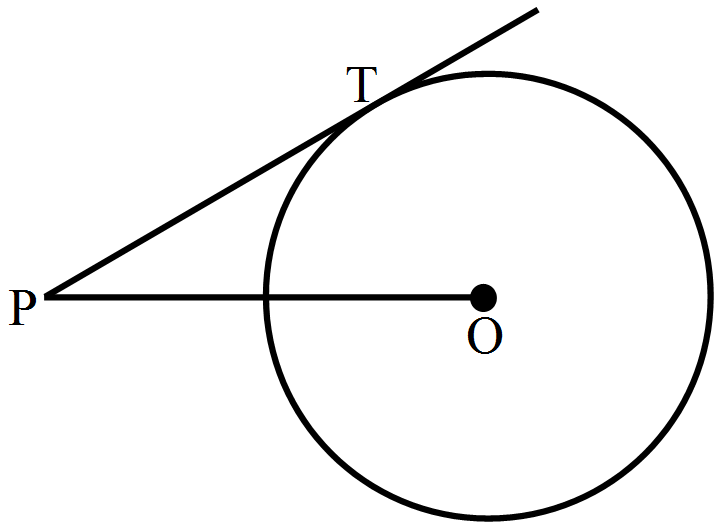
In the given figure, point $P$ is $26\ cm$ away from the centre $O$ of a circle and the length $PT$ of the tangent drawn from $P$ to the circle is $24\ cm$. Then the radius ofthe circle is :
If $\alpha,\ \beta$ are the zeros of the polynomial $x^2 + 6x + 2$, then $\Big(\frac{1}{\alpha}+\frac{1}{\beta}\Big)=?$
The most frequent value in the data is known as