MCQ
Second harmonic of open pipe is:
  • A
    fundamental frequency
  • first overtone
  • C
    second overtone
  • D
    third overtone

Answer

Correct option: B.
first overtone
(B)

Need a full question paper?

Generate a complete, print-ready paper with questions like this in minutes — across 16+ boards, with answer keys.

Start Generating Free

Similar questions

Solid cylinders of radii ${r_1},\,{r_2}$ and ${r_3}$ roll down an inclined plane from the same place simultaneously. If ${r_1} > {r_2} > {r_3}$, which one would reach the bottom first
The angle made by the vector $A = \hat i + \hat j$ with $x-$ axis is ....... $^o$
Two objects A and B are thrown upward simultaneously with the same speed. The mass of A is greater than the mass of B. Suppose the air exerts a constant and equal force of resistance on the two bodies:
  1. The two bodies will reach the same height.
  2. A will go higher than B.
  3. B will go higher than A.
  4. Any of the above three may happen depending on the speed with which the objects are thrown.
A force $\overrightarrow{ F }=(\hat{ i }+2 \hat{ j }+3 \hat{ k }) N$ acts at a point $(4 \hat{ i }+3 \hat{ j }-\hat{ k }) m \cdot$ Then the magnitude of torque about the point $(\hat{i}+2 \hat{j}+\hat{k}) m$ will be $\sqrt{ x } N - m .$ The value of $x$ is$........$
The length of a cylinder is measured with a metre rod having least count $0.1 \;cm$. Its diameter is measured with vernier calipers having least count $0.01\; cm$. If the length and diameter of the cylinder are $5.0\; cm$ and $2.00\; cm$, respectively, then the percentage error in the calculated value of volume will be
The height of water rising in a capillary will be:
The angular velocity of rotation of star (of mass $M$ and radius $R$) at which the matter start to escape from its equator will be
A body falling for $2 \,seconds$ covers a distance $S$ equal to that covered in next second. Taking $g = 10\,m/{s^2},\,S =..........m$
The fundamental physical quantities that have same dimensions in the dimensional formulae of torque and angular momentum are
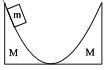
The inclined surfaces of two movable wedges of same mass $M$ are smoothly conjugated with the horizontal plane as shown in figure. $A$ washer of mass $m$ slides down the left wedge from a height $h$. To what maximum height will the washer rise along the right wedge? Neglect friction.