MCQ
$(\sec\text{A}+\tan\text{A})(1-\sin\text{A})=$
  • A
    $\sec\text{A}$
  • B
    $\sin\text{A}$
  • C
    $\text{cosec A}$
  • $\cos\text{A}$

Answer

Correct option: D.
$\cos\text{A}$
The given expression is $(\sec\text{A}+\tan\text{A})(1-\sin\text{A})$
Simplifying the given expression, we have
$(\sec\text{A}+\tan\text{A})(1-\sin\text{A})$
$=\Big(\frac{1}{\cos\text{A}}+\frac{\sin\text{A}}{\cos\text{A}}\Big)(1-\sin\text{A})$
$=\Big(\frac{1+\sin\text{A}}{\cos\text{A}}\Big)\times(1-\sin\text{A})$
$=\frac{(1+\sin\text{A})(1-\sin\text{A})}{\cos\text{A}}$
$=\frac{1-\sin^2\text{A}}{\cos\text{A}}$
$=\frac{\cos^2\text{A}}{\cos\text{A}}$
$=\cos\text{A}$
Therefore, the correct option is $(d).$

Need a full question paper?

Generate a complete, print-ready paper with questions like this in minutes — across 16+ boards, with answer keys.
Start Generating Free

Similar questions

Four alternative answers for each of the following questions are given. Choose the correct alternative.
A circle touches all sides of a parallelogram. So the parallelogram must be a,................... .
A. rectangle
B. rhombus
C. square
D. trapezium
$\triangle ABC \sim \triangle AQR . \quad \frac{A B}{A Q}=\frac{7}{5}$ then which of the following option is true.
Choose the correct alternative answer for each of the following question.
A die is rolled. What is the probability that the number appearing on upper face is less than 3?
 
The sum and product of the zeros of a quadratic polynomial are $3$ and $-10$ respectively. The quadratic polynomial is:
$5$ years hence, the age of a man shall be $3$ times the age of his son. while $5$ years earlier the age of the man was $7$ times the age of his son. The present age of the man is:
In a $\triangle\text{ABC, AD}$ is the bisector of $\angle\text{BAC}.$ If $\text{AB} = 6\ cm, \text{AC} = 5\ cm$ and $\text{BD} = 3\ cm,$ then $\text{DC} =$
Four alternative answers for each of the following questions are given. Choose the correct alternative.
Two circles intersect each other such that each circle passes through the centre of the other. If the distance between their centres is 12, what is the radius of each circle?
A. 6 cm
B. 12 cm
C. 24 cm
D. can’t say
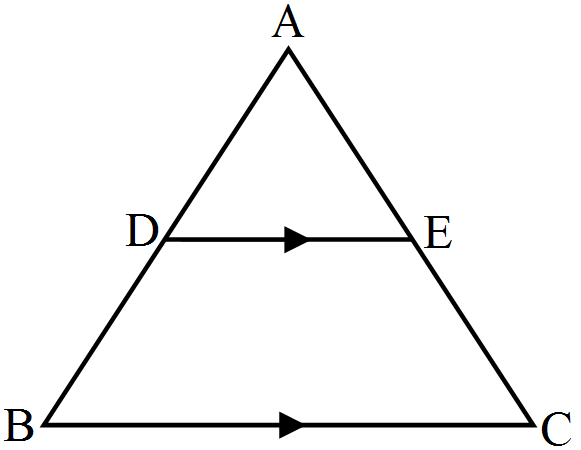
In $\triangle\text{ABC},\text{DE }\|\text{ BC}$ so that $AD = 2.4\ cm, AE = 3.2\ cm$ and $EC = 4.8\ cm.$ Then, $AB =?$
If a, b, c are sides of a triangle and a2 + b2 = c2, name the type of triangle.
The value of $\tan10^\circ\tan15^\circ\tan75^\circ\tan80^\circ$ is: