Question
Securities premium can also be utilized for three other purposes besides (i) ‘Issuing fully paid bonus shares’ and (ii) ‘Buy back of shares’. State those purposes.

Answer

The amount received as securities premium can be used other than ‘issue of bonus shares’ and ‘buy back of shares’ for the following purposes:
  • In writing off the preliminary expenses of the company.
  • For writing off the expenses, commission or discount allowed on issue of shares or debentures of the company.
  • For providing the premium payable on redemption of redeemable preference shares or debentures of the company.

Need a full question paper?

Generate a complete, print-ready paper with questions like this in minutes — across 16+ boards, with answer keys.

Start Generating Free

Similar questions

A firm normally has Trade Receivables equal to two months' Credit Sales. During the coming year it expects Credit Sales of ₹ 7,20,000 spread evenly over the year (12 months). What is the estimated amount of Trade Receivables at the end of the year?
Calculate Current Ratio from the following:
Working Capital ₹ 4,80,000; Trade Payables ₹ 2,00,000 and Bank Overdraft ₹ 40,000.
From the following particulars determine the Opening Trade Receivables:
‘David Ltd.’ issued ₹ 40,00,000 equity shares of ₹ 10 each out of its registered capital of ₹ 10,00,00,000. The amount payable on these shares was as follows:
On application – ₹ 1 per share
On allotment – ₹ 2 per share
On first call – ₹ 3 per share
On second and final call – ₹ 4 per share
All calls were made and were duly received, except the second and final call on 1,000 shares held by Vipul. These shares were forfeited.
Present the ‘Share Capital’ in the Balance Sheet of the company as per Schedule VI Part I of the Companies Act, 1956. Also prepare ‘Notes to Accounts’.
Current Ratio 4; Liquid Ratio 2.5; Inventory ₹ 6,00,000. Calculate Current Liabilities, Current Assets and Liquid Assets.
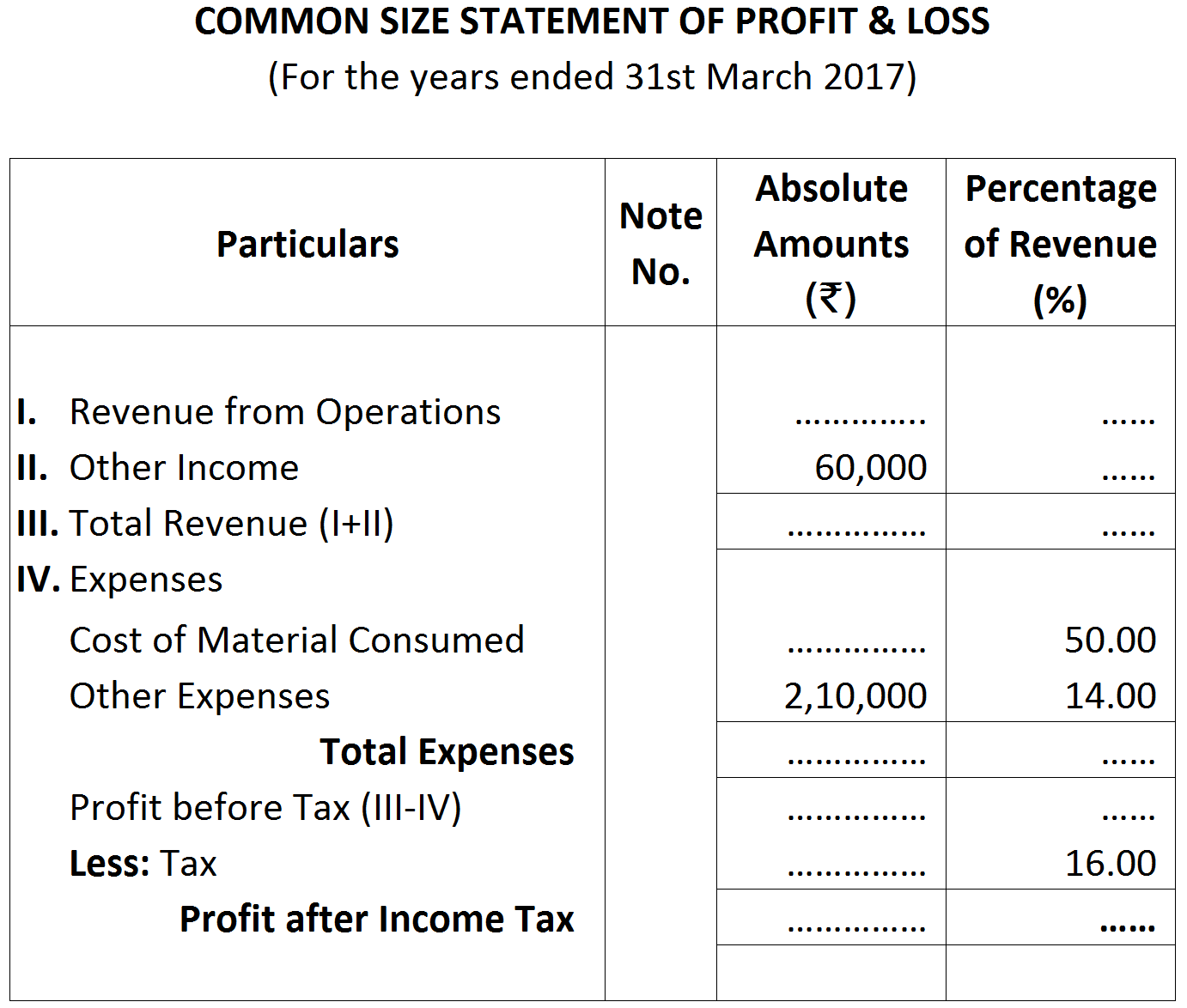
Fill in the missing figures in the following Common Size Statement of Profit & Loss:
Compute Trade Receivables Turnover Ratio from the following:
 
31st March, 2017 ()
31st March, 2018 ()
Revenue from Operations (Net Sales).
8,00,000
7,00,000
Debtors in the beginning of year.
83,000
1,17,000
Debtors at the end of year.
1,17,000
83,000
Sales Return.
1,00,000
50,000
Calculate 'Return on Capital Employed' from the following detail:
Gross Profit ₹ 2,70,000; Administration Expenses ₹ 60,000; Selling Expenses ₹ 30,000; 12% Long-Term Debts ₹ 2,00,000; Tax Rate 40%; Non Current Assets ₹ 6,00,000; Current Assets ₹ 2,00,000; and Current Liabilities ₹ 50,000.
A Company issued $36,000,11 \%$ Debentures of $₹ 50$ each at a discount of $4 \%$. The debentures are to be redeemed at par in equal proportions at the end of $4^{\text {th }}, 8^{\text {th }}$ and $12^{\text {th }}$ years. Show the amount of discount to be written off at the end of each year.
2,000 Equity Shares of ₹ 10 each were issued to Limited from whom assets of ₹ 25,000 were acquired. Pass Journal entry.