MCQ
Select correct option
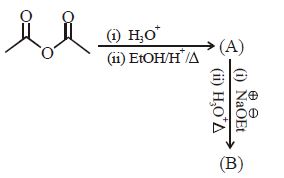
- ✓Compound $(B)$ is acetone
- BCommpound $(B)$ is acetic acid
- CCompound $(B)$ is ethyl acetate
- DCompound $(A)$ evolve $H_2(g)$ on reacting with $Na-$ metal
Generate a complete, print-ready paper with questions like this in minutes — across 16+ boards, with answer keys.
$(i)$ Neither with Fehling's solution nor with Tollen's reagent
$(ii)$ Only with Tollen's reagent but not with Fehling's solution
$(iii)$ With both Tollen's reagent and Fehling's solution. If they contained either ethanal (acetaldehyde) or propanone (acetone) or benzal (benzaldehyde), which bottle contained which
$(i)$ Methylamine $(ii)$ Phosgene
$(iii)$Phosphine $(iv)$ Dimethylamine
$C{H_3}C{H_2}OH\xrightarrow{{P + {I_2}}}A\xrightarrow[{Ether}]{{Mg}}B $ $\xrightarrow{{HCHO}}C\xrightarrow{{{H_2}O}}D,$
then compound $'D'$ is -
Reason : There is delocalisation of electrons from filled $d$ orbitals into the empty orbitals on the $CO$ ligands.
$M{n_{(S)}}|Mn_{(aq)}^{ + 2}(0.4\,M)||Sn_{(aq)}^{ + 2}(0.04\,M)|S{n_{(S)}}$,
Calculate free energy change $(\Delta G)$ at $298\,K$ .
Given :$E_{M{n^{ + 2}}|Mn}^o = \, - \,1.18\,V\,;\,E_{S{n^{ + 2}}|Sn}^o\, = \, - \,0.14\,volt$
$\frac{{2.303\,RT}}{F} = 0.06$