MCQ
Select correct statement regarding $[Ni(DMG)_2]$ complex compound
  • A
    It acts as oxidising agent because $Ni^{2+}$ cation is having $EAN\,34.$
  • B
    It is extra-stabilized by hydrogen bonding
  • C
    It's $IUPAC$ name is $B$ is (dimethylglyoximato) nickelate $(II)$
  • It's ligand contains two different donar sites

Answer

Correct option: D.
It's ligand contains two different donar sites
d

Need a full question paper?

Generate a complete, print-ready paper with questions like this in minutes — across 16+ boards, with answer keys.

Start Generating Free

Similar questions

Transition metals show paramagnetism due to:
$\begin{matrix}
   O\,\,\,\,\,\,\,\,\,\,\,\,\,\,\,\,\,\,\,\,\,\,\,\,\,\,\,\,\,\,\,\,\,\,\,\,\,\,\,\,\,\,\,\,\,\,\,\,\,\,\,\,\,\,\,\,\,\,\,\,\,\,\,\,\,\,\,\,\,\,\,\,\,\,\,\,\,\,\,\,\,\,\,\,O\,\,\,\,\,\,\,\,\,\,\,\,\,\,\,\,\,\,\,\,\,\,\,\,\,  \\
   ||\,\,\,\,\,\,\,\,\,\,\,\,\,\,\,\,\,\,\,\,\,\,\,\,\,\,\,\,\,\,\,\,\,\,\,\,\,\,\,\,\,\,\,\,\,\,\,\,\,\,\,\,\,\,\,\,\,\,\,\,\,\,\,\,\,\,\,\,\,\,\,\,\,\,\,\,\,\,\,\,\,\,\,\,\,\,||\,\,\,\,\,\,\,\,\,\,\,\,\,\,\,\,\,\,\,\,\,\,\,\,\,  \\
   C{{H}_{3}}-C-C{{H}_{2}}-C{{H}_{2}}-C{{H}_{2}}-C{{H}_{2}}-C-H\xrightarrow{H{{O}^{-}}/\Delta }\underset{(73\%)}{\mathop{(A)}}\,;  \\
\end{matrix}$ Product $(A)$ is
The specific conductance of solution depends upon -
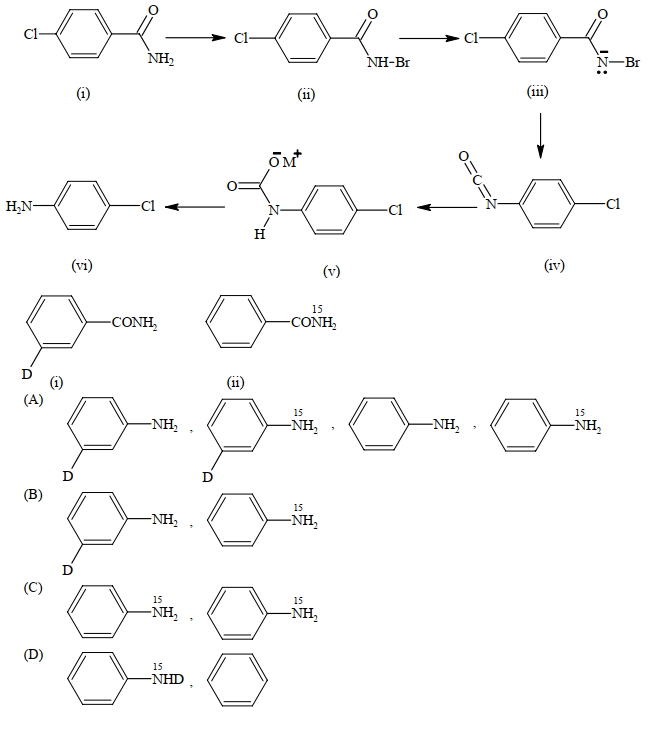
$\mathrm{RCONH}_2$ is converted into $\mathrm{RNH}_2$ by means of Hofmann bromamide degradation.

$Image$

In this reaction, $\mathrm{RCONHBr}$ is formed from which this reaction has derived its name. Electron donating group at phenyl activates the reaction. Hofmann degradation reaction is an intramolecular reaction.

$1.$  How can the conversion of $(i)$ to $(ii)$ be brought about?

$(A)$ $\mathrm{KBr}$  $(B)$ $\mathrm{KBr}+\mathrm{CH}_3 \mathrm{ONa}$  $(C)$ $\mathrm{KBr}+\mathrm{KOH}$  $(D)$ $\mathrm{Br}_2+\mathrm{KOH}$

$2.$  Which is the rate determining step in Hofmann bromamide degradation?

$(A)$ Formation of $(i)$  $(B)$ Formation of $(ii)$  $(C)$ Formation of $(iii)$  $(D)$ Formation of $(iv)$

$3.$  What are the constituent amines formed when the mixture of $(i)$ and $(ii)$ undergoes Hofmann bromamide degradation?

$Image$

give the answer question $1$, $2$, and $3.$

A catalyst lowers the activation energy for a certain reaction from $83.314$ to $75 \,KJ\,mol^{-1}$ at $500\,K$ . What will be the rate of reaction as compare to uncatalysed reaction ? Assume other things being equal ....... $times$
Paris green is
The number of stereoisomers possible for a compound of the molecular formula

$C{H_3} - CH = CH - CH\left( {OH} \right) - Me$ is

$IUPAC $ name of ${K_3}Fe{(CN)_6}$ is
Salicylic acid, picric acid, aspirin, nylon and plastics have a common raw material, namely:
A catalyst increases the rate of reaction because it