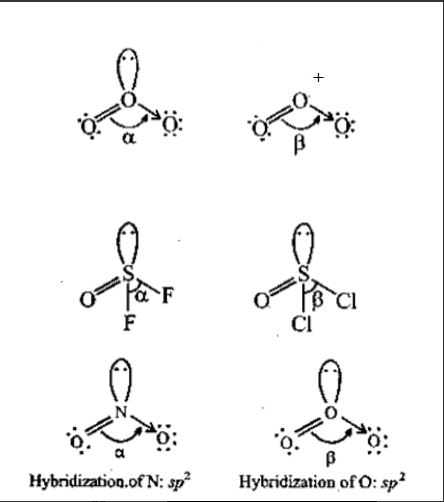
Correct option: D.$AsH_3, O_3^+, O_3, SOF_2$
d
The molecule or ion having the smallest bond angle are $\mathrm{AsH}_{3}, \mathrm{O}_{3}, \mathrm{NO}_{2}^{-}, \mathrm{SOF}_{2}$.
(i) According to Drago's rule, the trend of decreasing bond angle in $\mathrm{NH}_{3}, \mathrm{PH}_{3},$ and $\mathrm{AsH}_{3}$ is :
$\mathrm{NH}_{3}>\mathrm{PH}_{3}>\mathrm{AsH}_{3}$
(ii) $\alpha<\beta$ because lone pair-double repulsion in $\mathrm{O}_{3}$ is greater than single electron-double bond in $\mathrm{O}_{3}^{+}$ .
Also, lone pair-single bond (electron pair) repulsion in $\mathrm{O}_{3}$ is greater than single electronsingle bond repulsion in $\mathrm{O}_{3}^{+}$
(iii) According to Bent's rule, $\mathrm{N}-\mathrm{O}$ bond $(\mathrm{B} . \mathrm{O} \cdot \mathrm{r}=1.5)$ in $\mathrm{N} \mathrm{O}_{2}^{-}$ has more p character than $\mathrm{O}-\mathrm{O}$ bond (B.O. $=1.5)$ in $\mathrm{O}_{3}$. Hence $\alpha<\beta$.
(iv) According to Bent's rule, there is more $\mathrm{p}$ -character in $\mathrm{S}-\mathrm{F}$ bond than in $\mathrm{S}-\mathrm{Cl}$ bond in $\mathrm{SOCl}_{2}$. Hence $\alpha<\beta$