MCQ
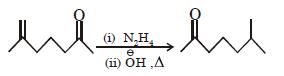
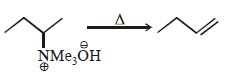
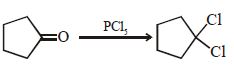
Select option in which incorrect major product is shown

  • B

  • C

  • D
    $Ph - I\xrightarrow[\Delta ]{{Cu}}Ph - Ph$

Answer

Correct option: A.

a

Need a full question paper?

Generate a complete, print-ready paper with questions like this in minutes — across 16+ boards, with answer keys.

Start Generating Free

Similar questions

Which of the following is by-product in the reaction of obtaining phenol from cumene?
Which metal is present in brass, bronze and German silver
The reaction $2 NO + Br _2 \rightarrow 2 NOBr$

takes places through the mechanism given below :

$NO + Br _2 \Leftrightarrow NOBr _2 \text { (fast) }$

$NOBr _2+ NO \rightarrow 2 NOBr \text { (slow) }$

The overall order of the reaction is $.....$.

Calculate the amount of water evaporated if $2.8\ kg$ of $2\ m\ CaBr_2$ solution is heated to $110\,^o\ C$ at $1\ atm$ .......... $gm$

(Given : $K_b$ of water $=0.5\ Kkg/mol$ . ; Atomic mass of $Ca =40$ , $Br =80$)

If $1\, A$ of current is passed through $CuS{O_4}$ solution for $10$ seconds, then the number of copper ions deposited at the cathode will be about
For the cell reaction......$kJ\, mol^{-1}$

$2 \mathrm{Fe}^{3+}(\mathrm{aq})+2 \mathrm{I^-}(\mathrm{aq}) \rightarrow 2 \mathrm{Fe}^{2+}(\mathrm{aq})+\mathrm{I}_{2}(\mathrm{aq})$

$\mathrm{E}_{\text {call }}^{\mathrm{e}}=0.24 \mathrm{V}$ at $298\; \mathrm{K}$. The standard Gibbs energy $\left( {{\Delta _r}{{\rm{G}}^ \ominus }} \right)$ of the cell reaction is:

[Faraday constant $\mathrm{F}=96500 \;\mathrm{C} \mathrm{mol}^{-1} $]

When an electric current is passed through acidulated water $112\, mL$ of hydrogen gas at $N.T.P.$ collect at the cathode in $965\, seconds$. The current passed, in amperes is
$1.8\, g$ of fructose is added to $2\, kg$ of water. The freezing point of the solution is $(k_f = 1.86\, K\, m^{-1})$
A solution of sodium sulphate in water is electrolysed using inert electrodes. The products at the cathode and anode are respectively
A $\left[\mathrm{Cr}\left(\mathrm{H}_2 \mathrm{O}\right)_6\right]^{3+}$ typically absorbs at around $574\ nm.$ It is allowed to react with ammonia to form a new complex $\left[\mathrm{Cr}\left(\mathrm{NH}_3\right)_6\right]^{3+}$ that should have absorption at: