MCQ
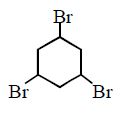
Select the best method for the preparation of the following compounds
  • A
    reaction of cyclohexanone with $CH_3Li$
  • B
    reaction of $1-$ methylcyclohexene with $Hg(OAc)_2$ followed by $NaBH_4$
  • C
    reaction of cyclohexene with $BH_3 ; NaOH/H_2O_2,$ following by $CH_3Br$
  • reaction of cyclohexene with $MCPBA$, followed by $CH_3MgBr$

Answer

Correct option: D.
reaction of cyclohexene with $MCPBA$, followed by $CH_3MgBr$
d

Need a full question paper?

Generate a complete, print-ready paper with questions like this in minutes — across 16+ boards, with answer keys.

Start Generating Free

Similar questions

$0.05 \mathrm{~cm}$ thick coating of silver is deposited on a plate of $0.05 \mathrm{~m}^2$ area. The number of silver atoms deposited on plate are__________ $\times 10^{23}$. (At mass Ag $\left.=108, \mathrm{~d}=7.9 \mathrm{~g} \mathrm{~cm}^{-3}\right)$
The valency of $A = 3$ and $B = 2$, then the compound is
Iodoform test is not given by
Molar conductances of $BaCl_2, H_2SO_4$ and $HCl$ at infinite dilutions are $x_1, x_2$  and $x_3$, respectively. Equivalent conductance of $BaSO_4$ at infinite dilution  will be
Which of the following are redox changes?
$(i)$ Hydrolysis of $XeF_2$
$(ii)$ Thermal decomposition of $Ag_2CO_3$
$(iii)$ Reaction of $Al$ with $NaOH$
$(iv)$ Hydrolysis Of $PCl_5$
$(v)$ Reaction of NaCl with conc. $H_2SO_4$
Correct options are
For the reaction at $25\,^oC,$ ${N_2}{O_4}_{(g)\,}\, \rightleftharpoons \,2N{O_2}_{(g)}$  if $\Delta G_f^o$ for $N_2O_4$ and $NO_2$ are $23. 49$ and $12.39\,KCal$ respectively then $K_p$ for the reaction is
Total number of stereo isomers possible by given compound is
$N{a_2}{B_4}{O_7}.10{H_2}O\,\xrightarrow{\Delta }$ $NaB{O_2} + \,(A)\, + \,{H_{2\,}}O(A)\, + $ $MnO\,\xrightarrow{\Delta }\,(B),\,(A)$ and $(B)$ are
In the cell  $Pt(s)| H_2 (g,1\,bar)| HCl(aq)| AgCl(s)| Ag(s)| Pt(s)$ the cell potential is $0.92\,V$ when a $10^{-6}$ molal $HCl$ solution is used. The standard electrode potential of $(AgCl / Ag,Cl^- )$ electrode is ............. $\mathrm{V}$ $\left\{ {Given,\frac{{2.303RT}}{F} = 0.06\,V\,at\,298\,K} \right\}$ 
The following thermochemical reactions are given$M + \frac{1}{2}{O_2}\,\, \to \,\,MO + 351.4\,kJ$

$X + \frac{1}{2}{O_2}\,\, \to \,\,XO + 90.8\,kJ$

It follows that the heat of reaction for the following process $M + XO$ $\rightleftharpoons$ $MO + X$ is given by......$kJ$