MCQ
Select the correct choice(s) :
  • A
    The gravitational field insideaspherical cavity,with inaspherical planet must be non zero and uniform.
  • B
    When a body is projected horizontally at an appreciable large height above the earth, with a velocity less than for a circular orbit, it will fall to the earth along a parabolic path.
  • Abody of zero total mechanical energy placed in a gravitational field will escape the field
  • D
    Earth’s satellite must be in equatorial plane .
Answer

Correct option: C.
Abody of zero total mechanical energy placed in a gravitational field will escape the field
c
Gravitational field is conservative field, total mechanical energy is conserved. If a body is in gravitational field with $U+K=0 \rightarrow K=-U \rightarrow(1)$ i.e. Kinetic energy is non zero.So, it will move away from the field till its kinetic energy is also zero.

If $K=0 \rightarrow U=0$ from $(1).$ But, $U=0$ is at $\infty$ and thus the body escapes the field.

Need a full question paper?

Generate a complete, print-ready paper with questions like this in minutes — across 16+ boards, with answer keys.

Start Generating Free

Similar questions

A body of mass $M$ thrown horizontally with velocity $v$ from the top of the tower of height $\mathrm{H}$ touches the ground at a distance of $100 \mathrm{~m}$ from the foot of the tower. A body of mass $2 \mathrm{M}$ thrown at a velocity $\frac{v}{2}$ from the top of the tower of height $4 \mathrm{H}$ will touch the ground at a distance of. . . . ..  
When a rubber band is stretched by a distance $x$, it exerts a restoring force $F = ax + bx^2$, where $a$ and $b$ are constants. Work done in stretching rubber band by distance $L$ from its unstretched position is
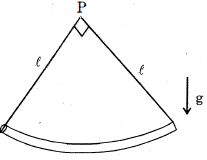
A circular arc of mass $m$ is connected with the help of two massless strings as shown in the figuw in vertical plane. About point $P$, small oscillations are given in the plane of the arc. Time period of the oscillations of $SHM$ will be
Planck's constant $h$, speed of light $c$ and gravitational constant $G$ are used to form a unit of length $L$ and a unit of mass $M$. Then the correct option$(s)$ is(are)

$(A)$ $M \propto \sqrt{ c }$ $(B)$ $M \propto \sqrt{ G }$ $(C)$ $L \propto \sqrt{ h }$ $(D)$ $L \propto \sqrt{G}$

The escape speed of a projectile on the earth's surface is $11.2\; km s ^{-1} .$ A body is projected out with thrice this speed. What is the speed (in $km/s$) of the body far away from the earth? Ignore the presence of the sun and other planets.
A boat takes two hours to travel $8 \,km$ and back in still water. If the velocity of water is $4\, km/h$, the time taken for going upstream $8 \,km$ and coming back is
The intensity of radiation emitted by the sun has its maximum value at a wavelength of $510\;nm$ and that emitted by the north star has the maximum value at $350\;nm$. If these stars behave like black bodies, then the ratio of the surface temperature of the sun and north star is
A projectile is thrown with some initial velocity at an angle $\alpha$ to the horizontal. Its velocity when it is at the highest point is $(2 / 5)^{1 / 2}$ times the velocity when it is at height half of the maximum height. Find the angle of projection $\alpha$ with the horizontal.
Two point masses $m$ and $M$ are separated by a distance $L$. The distance of the centre of mass of the system from m is
A solid homogenous sphere of mass $M$ and radius $r$ is moving on a rough horizontal surface, partly rolling and partly sliding. During this kind of motion of this sphere