MCQ
Select the correct statement
  • In a full wave rectifier, two diodes work alternately
  • B
    In a full wave rectifier, two diodes work simultaneously
  • C
    The efficiency of full wave and half wave rectifiers is same
  • D
    The full wave rectifier is bi-directional.
Answer

Correct option: A.
In a full wave rectifier, two diodes work alternately
 In a full wave rectifier, two diodes work alternately

Need a full question paper?

Generate a complete, print-ready paper with questions like this in minutes — across 16+ boards, with answer keys.

Start Generating Free

Similar questions

Two thin lenses, one of focal length + 60 cm and the other of focal length – 20 cm are put in contact. The combined focal length is
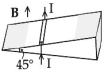
As shown in the figure, a metallic rod of linear density $0.45\,kg\,m ^{-1}$ is lying horizontally on a smooth incline plane which makes an angle of $45^{\circ}$ with the horizontal. The minimum current flowing in the rod required to keep it stationary, when $0.15\,T$ magnetic field is acting on it in the vertical upward direction, will be $....A$ $\left\{\right.$ Use $\left.g=10 m / s ^{2}\right\}$
A convex lens of focal length $40 \mathrm{~cm}$ forms an image of an extended source of light on a photoelectric cell. A current I is produced. The lens is replaced by another convex lens having the same diameter but focal length $20 \mathrm{~cm}$. The photoelectric current now is:
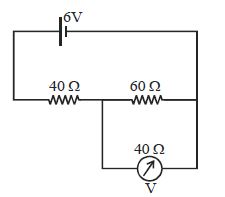
The reading of voltmeter in the circuit shown is ............. $V$
Due to $S.C.R$ in vacuum tube
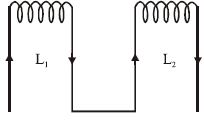
A circuit contains two inductors of self inductance $L_1$ and $L_2$ in series (Fig). If $M$ is the mutual inductance, then the effective inductance of the circuit shown will be
The magnetic field at the centre of a circular coil of radius r carrying current I is $B_1$. The field at the centre of another coil of radius 2 r carrying same current I is $B_2$. The ratio $\frac{B_1}{B_2}$ is
The resultant of $\overrightarrow{\text{A}}$ and $\overrightarrow{\text{B}}$ makes an angle a with $\overrightarrow{\text{A}}$ and $\beta$ with $\overrightarrow{\text{B}},$
When a test charge is brought in from infinity along the perpendicular bisector of an electric dipole, the work done is ..........
Huygens' concepts of secondary wavelets