Question
Select the correct statement about rainbow.

Answer

(b)

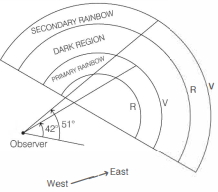
In late afternoon rainbow is visible in east side when light of sun in west side is reflected and refracted by a layer of water droplets.

Rainbow is circular because locous of reflected rays reaching eye of observer is a circle. Its roundness is not due to roundness of earth.

There is no rainbow on moon due to lack of atmosphere.

In case of a primary rainbow, violet colour is on inside and red colour is on outside of arc.

In case of a secondary rainbow, red colour is on inside and violet colour is on outside of arc.

So, none of the option is correct. Option $(b)$ is correct, if only secondary rainbow is considered.
Need a full question paper?

Generate a complete, print-ready paper with questions like this in minutes — across 16+ boards, with answer keys.

Start Generating Free

Similar questions

Material A has critical angle ${i_A},$ and material $B$ has critical angle ${i_B}({i_B} > {i_A}).$ Then which of the following is true

$(i)$ Light can be totally internally reflected when it passes from $B$ to $A$

$(ii)$ Light can be totally internally reflected when it passes from $A$ to $B$

$(iii)$ Critical angle for total internal reflection is ${i_B} - {i_A}$

$(iv)$ Critical angle between $A$ and $B$ is ${\sin ^{ - 1}}\left( {\frac{{\sin {i_A}}}{{\sin {i_B}}}} \right)$

This question has a paragraph followed by two statements, Statement $- 1$ and Statement $- 2$. Of the given four alternatives after the statements, choose the one that describes the statements.
A thin air film is formed by putting the convex surface of a plane-convex lens over a plane glass plate. With monochromatic light, this film gives an interference pattern due to light reflected from the top ( convex) surface and the bottom (glass plate) surface of the film.
Statement $- 1$ : When light reflects from the air-glass plate interface, the reflected wave suffers a phase change of $\pi$.
Statement $- 2$ : The centre of the interference pattern is dark.
A thin conducting rod $\mathrm{MN}$ of mass $20 \mathrm{gm}$, length $25 \mathrm{~cm}$ and resistance $10 \Omega$ is held on frictionless, long, perfectly conducting vertical rails as shown in the figure. There is a uniform magnetic field $\mathrm{B}_0=4 \mathrm{~T}$ directed perpendicular to the plane of the rod-rail arrangement. The rod is released from rest at time $t=0$ and it moves down along the rails. Assume air drag is negligible. Match each quantity in List-$I$ with an appropriate value from List-$II$, and choose the correct option. [Given: The acceleration due to gravity $g=10 \mathrm{~ms}^{-2}$ and $e^{-1}=0.4$ ]
List-$I$ List-$II$
($P$) At $t=0.2 \mathrm{~s}$, the magnitude of the induced emf in Volt ($1$) $\quad 0.07$
($Q$) At $t=0.2 \mathrm{~s}$, the magnitude of the magnetic force in Newton $(2) 0.14$
($R$) At $t=0.2 \mathrm{~s}$, the power dissipated as heat in Watt $(3) 1.20$
($S$) The magnitude of terminal velocity of the rod in $\mathrm{m} \mathrm{s}^{-1}$ $(4) 0.12$
  $(5) 2.00$

Positive rays was discovered by
In photoelectric effect, the electrons are ejected from metals if the incident light has a certain minimum
A spring $40 \,mm$ long is stretched by the application of a force. If $10 \,N$ force required to stretch the spring through $1 \,mm$, then work done in stretching the spring through $40\, mm$ is ............. $\mathrm{J}$
A mixture of benzaldehyde and formaldehyde on heating with aqueous $NaOH$ solution gives
An electron, a proton and an alpha particle having the same kinetic energy are moving in circular orbits of radii $r_e,r_p$ and ${r_\alpha }$ respectively in a uniform magnetic field $B$. The relation between $r_e,r_p$ and $\;{r_\alpha }$ is
Two waves are represented by ${y_1} = a\sin \left( {\omega \,t + \frac{\pi }{6}} \right)$ and ${y_2} = a\cos \omega \,t$. What will be their resultant amplitude
Find unit vector perpendicular to $\vec A$ and $\vec B$ where $\vec A = \hat i - 2\hat j + \hat k$ and $\vec B = \hat i + 2\hat j$