MCQ
Select the correct statement from the following
  • A
    Electromagnetic waves cannot travel in vacuum
  • B
    Electromagnetic waves are longitudinal waves
  • C
    Electromagnetic waves are produced by charges moving with uniform velocity
  • Electromagnetic waves carry both energy and momentum as they propagate through space
Answer

Correct option: D.
Electromagnetic waves carry both energy and momentum as they propagate through space
d
Electromagnetic waves do not required any medium to propagate. They can travel in  vacuum. They are transverse in nature like light. They carry both energy and momentum. A changing electric field produces a changing magnetic field and vice-versa . Which gives rise to a transverse wave known as electromagnetic wave

Need a full question paper?

Generate a complete, print-ready paper with questions like this in minutes — across 16+ boards, with answer keys.

Start Generating Free

Similar questions

Open container contains $x$ mole of gas at $T$ $kelvin$ If temperature is tripled, then the amount of gas exit the container is
Two persons are holding a rope of negligible weight tightly at its ends so that it is horizontal. A $15\, kg$ weight is attached to the rope at the mid-point, which now no longer remains horizontal. The minimum tension required to completely straighten the rope is
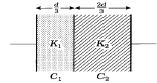
A parallel plate capacitor with air between the plates has capacitance of $9\ pF$. The separation between its plates is '$d$'. The space between the plates is now filled with two dielectrics. One of the dielectrics has dielectric constant $k_1 = 3$ and thickness $\frac{d}{3}$ while the other one has dielectric constant $k_2 = 6$ and thickness $\frac{2d}{3}$ . Capacitance of the capacitor is now.......$pF$
A proton, a deuteron and an $\alpha$ particle are moving with same momentum in a uniform magnetic field. The ratio of magnetic forces acting on them is.......... and their speed is.................. in the ratio.
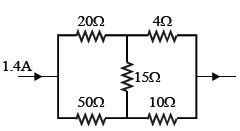
In the given figure the current through $4\,\Omega$ resistor is .................. $\mathrm{A}$
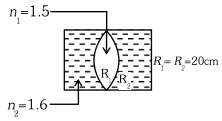
In the figure shown here, what is the equivalent focal length (in $cm$) of the combination of lenses (Assume that all layers are thin)?
For comparing the $e.m.f.$'s of two cells with a potentiometer, a standard cell is used to develop a potential gradient along the wires. Which of the following possibilities would make the experiment unsuccessful
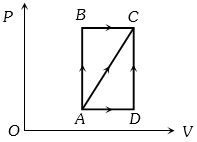
A thermodynamic process is shown in the figure. The pressures and volumes corresponding to some points in the figure are :

${P_A} = 3 \times {10^4}Pa,\;{P_B} = 8 \times {10^4}Pa$ and ${V_A} = 2 \times {10^{ - 3}}{m^3},\;{V_D} = 5 \times {10^{ - 3}}{m^3}$

In process $AB$, $600 J$ of heat is added to the system and in process $BC, 200 J $ of heat is added to the system. The change in internal energy of the system in process $ AC$ would be ...... $J$

An expression of energy density is given by $u=\frac{\alpha}{\beta} \sin \left(\frac{\alpha x}{k t}\right)$, where $\alpha, \beta$ are constants, $x$ is displacement, $k$ is Boltzmann constant and $t$ is the temperature. The dimensions of $\beta$ will be.
An air core solenoid has $1000$ turns and is one metre long. Its cross-sectional area is $10$ $cm$$^2$. Its self inductance is