MCQ
Select the correct statement regardings sulphur :-
  • A
    At high temperature it's paramagnetic
  • B
    $S-S$ has less bond energy than $O-O$ bond
  • C
    Sulphur exist in $S_8$ form and it has cage like structure.
  • Size of sulphur is greater than oxygen so, it (sulphur) has less electron a affinity than oxygen.
Answer

Correct option: D.
Size of sulphur is greater than oxygen so, it (sulphur) has less electron a affinity than oxygen.
d
$S_2O_7^{2-}$

$\begin{array}{*{20}{c}}
  {\begin{array}{*{20}{c}}
  {O\,\,\,\,\,\,\,\,\,\,\,\,\,\,\,\,\,\,\,O} \\ 
  {||\,\,\,\,\,\,\,\,\,\,\,\,\,\,\,\,\,\,\,\,\,\,||} 
\end{array}} \\ 
  {^ - O - S - O - S - {O^ - }} \\ 
  {\,\,\,\,\,\,\,\,\,||\,\,\,\,\,\,\,\,\,\,\,\,\,\,\,\,\,\,\,\,\,\,||\,\,\,\,\,\,\,\,} \\ 
  {\,O\,\,\,\,\,\,\,\,\,\,\,\,\,\,\,\,\,\,\,O} 
\end{array}$

No. $S-S$ linkage

Need a full question paper?

Generate a complete, print-ready paper with questions like this in minutes — across 16+ boards, with answer keys.

Start Generating Free

Similar questions

In which of the following processes entropy increases?

$A$. A liquid evaporates to vapour.

$B$. Temperature of a crystalline solid lowered from $130 \mathrm{~K}$ to $0 \mathrm{~K}$.

$C$. $2 \mathrm{NaHCO}_{3(\mathrm{~s})} \rightarrow \mathrm{Na}_2 \mathrm{CO}_{3(\mathrm{~s})}+\mathrm{CO}_{2(\mathrm{~g})}+\mathrm{H}_2 \mathrm{O}_{(\mathrm{g})}$

$D$. $\mathrm{Cl}_{2(g)} \rightarrow 2 \mathrm{Cl}_{(g)}$

Choose the correct answer from the options given below:

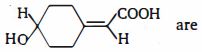
Two possible stereoisomers for
Electrolysis of molten anhydrous calcium chloride produces
What is the molar concentration of chloride ion in a solution made by adding $300\,ml$ of $3.0\,M\,KCl$ solution to a $200 \,ml$ of $4.0\,M\,BaCl_2$ solution ? ........ $M$
Thiosulphate reacts differently with iodine and bromine in the reaction given below :

$ 2 \mathrm{~S}_2 \mathrm{O}_3^{2-}+\mathrm{I}_2 \rightarrow \mathrm{S}_4 \mathrm{O}_6^{2-}+2 \mathrm{I}^{-}$

$\mathrm{S}_2 \mathrm{O}_3^{2-}+5 \mathrm{Br}_2+5 \mathrm{H}_2 \mathrm{O} \rightarrow 2 \mathrm{SO}_4^{2-}+4 \mathrm{Br}^{-}+10 \mathrm{H}^{+}$

Which of the following statement justifies the above dual behaviour of thiosulphate?

$2.2\, g$ of nitrous oxide $\left( N _{2} O \right)$ gas is cooled at a constant pressure of $1\, atm$ from $310\, K$ to $270 \,K$ causing the compression of the gas from $217.1 \,mL$ to $167.75 \,mL$. The change in internal energy of the process, $\Delta U$ is ' $- x ^{\prime} J$. The value of ' $x$ ' is $....$

[nearest integer]

(Given: atomic mass of $N =14\, g \,mol ^{-1}$ and of $O$ $=16\, g\, mol ^{-1}$.

Molar heat capacity of $N _{2} O$ is $100\, JK ^{-1}\, mol ^{-1}$ )

Complex compound $(s)$ having even number of space (stereo) isomers is/are : 
(where $AA-$ symmetrical bidentate ligand and $a,b,c,d,e-$ monodentate ligands)
$'C - C'$ bond length in benzene lies between single and double bond. The reason is
Which of the following is erythro form and optically active ?
The equivalent conductance at infinite dilution $\left( {{ \wedge ^0}} \right)$ for electrolytes $BA$ and $CA$ are $140$ and $120\  S\  cm^2 eq^{-1}$. The equivalent conductance at infinite dilution for $BX$ is $198\  S \ cm^2 eq^{-1}$. The ${ \wedge ^0}$ (in $S\  cm^2 eq^{-1}$) of $CX$ is