MCQ
Self induction of a solenoid is
  • A
    Directly proportional to current flowing through the coil
  • B
    Directly proportional to its length
  • Directly proportional to area of cross-section
  • D
    Inversely proportional to area of cross-section

Answer

Correct option: C.
Directly proportional to area of cross-section
c
(c) $L = {\mu _0}{N^2}A\, /l$

Need a full question paper?

Generate a complete, print-ready paper with questions like this in minutes — across 16+ boards, with answer keys.
Start Generating Free

Similar questions

The energy of an $X-$ ray photon of wavelength $1.65 Å$ is.......$keV$ $(h = 6.6 \times {10^{ - 34}}J{\rm{ - }}sec,\,\,c = 3 \times {10^8}m{s^{ - 1}}$, $1eV = 1.6 \times {10^{ - 19}}J)$
A soap film of surface tension $3 \times {10^{ - 2}}\,N{m^{ - 1}}$ formed in rectangular frame, can support a straw. The length of the film is $10\, cm$. Mass of the straw the film can support is ........ $gm$
A polariser is used to
A sinusoidal voltage of peak value $283\, V$ and angular frequency $320/s$ is applied to a series $LCR$ circuit. Given that $R\, = 5\,\Omega $ , $L\,= 25\, mH$ and $C\, = 1000\, \mu F$. The total impedance, and phase difference between the voltage across the source and the current will respectively be
A potentiometer has uniform potential gradient across it. Two cells connected in series $(i)$ to support each other and $(ii)$ to oppose each other are balanced over $6\,m$ and $2\,m$ respectively on the potentiometer wire. The $e.m.f.$’s of the cells are in the ratio of
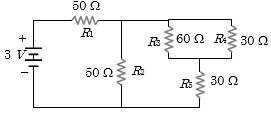
In circuit shown below, the resistances are given in $ohms$ and the battery is assumed ideal with emf equal to $3\, volt$. The voltage across the resistance $R_4$ is ................. $V$
Dual nature of radiation is shown by
A heater draws a current of $2\,A$ when connected to a $250\,V$ source. The rate of energy dissipation is ............. $W$
If mean wavelength of light radiated by $100 W$ lamp is $5000 Å$, then number of photons radiated per second are
Positive and negative point charges of equal magnitude are kept at $\left(0,0, \frac{a}{2}\right)$ and $\left(0,0, \frac{-a}{2}\right)$, respectively. The work done by the electric field when another positive point charge is moved from $(-a, 0,0)$ to $(0, a, 0)$ is