MCQ
Set of orbital filled just after the filling of electron in atom $z = 56$ is
  • A
    $\boxed{6p}\,\,\boxed{7s}\,\,\boxed{5f}$
  • B
    $\boxed{5d}\,\,\boxed{6p}\,\,\boxed{7s}$
  • C
    $\boxed{6s}\,\,\boxed{4f}\,\,\boxed{5d}$
  • $\boxed{4f}\,\,\boxed{5d}\,\,\boxed{6p}$
Answer

Correct option: D.
$\boxed{4f}\,\,\boxed{5d}\,\,\boxed{6p}$
d
$_{56}Ba = \left[ {xe} \right]\,6{s^2} \to \,\boxed{4f}\, \to \boxed{5d}\, \to \boxed{6p}\, \to \boxed{7s}.....$

Need a full question paper?

Generate a complete, print-ready paper with questions like this in minutes — across 16+ boards, with answer keys.

Start Generating Free

Similar questions

$\begin{array}{*{20}{c}}
  {C{H_3} - CH - CH = C{H_2}} \\ 
  {|\,\,\,\,\,\,\,\,\,\,\,\,\,\,\,\,\,\,\,\,} \\ 
  {C{H_3}\,\,\,\,\,\,\,\,\,\,\,\,\,\,} 
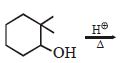
\end{array}$ $\xrightarrow{{{\text{D}}Br}}\,Product \,\left( {Major} \right)$ Product will be
$0.1\,gm$ of organic compound was analysed by Kjeldahl's method. In analysis produced $NH_3$ absorbed in $30\, ml\, N/5\, H_2SO_4$ . The remaining acid required $20\, ml\, N/10\, NaOH$ for neutralisation. Calculate percentage.......$\%$ of nitrogen in organic compound
The pressure in well inflated tyres of automobiles is almost constant, but on a hot summer day this increases considerably and tyre may burst. This phenomena is explained by :
The shape/structure of $\left[ XeF _{5}\right]^{-}$ and $XeO _{3} F _{2}$
respectively, are :
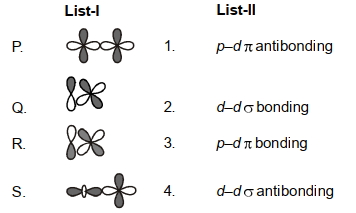
Match the orbital overlap figures shown in List-$I$ with the description given in List-$II$ and select the correct answer using the code given below the lists. $Image$

Codes: $ \quad P \quad Q \quad R \quad S $

Consider a helium $( He )$ atom that absorbs a photon of wavelength $330 nm$. The change in the velocity (in $cm s ^{-1}$ ) of He atom after the photon absorption is. . . . . . 

(Assume: Momentum is conserved when photon is absorbed. Use: Planck constant $=6.6 \times 10^{-34} J s$, Avogadro number $=6 \times 10^{23} mol ^{-1}$, Molar mass of $He =4 g mol ^{-1}$ )

On moving from left to right across a period in the table the metallic character
Of the following the ion with the smallest ionic radius is
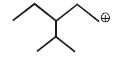
How many $1,2-$ shift takes place in following carbocation.
Major product is