MCQ
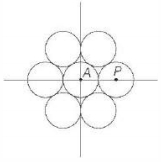
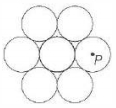
Seven identical coins are rigidly arranged on a flat table in the pattern shown below, so that each coin touches its neighbours. Each coin is a thin disc of mass $m$ and radius $r$. Here note, that the moment of inertia of an individual coin about an axis passing through centre and perpendicular to the plane of the coin is $\frac{m r^2}{2}$.The moment of inertia of the system of seven coins about an axis that passes through the point $P$ (the centre of the coin positioned directly to the right of the central coin) and perpendicular to the plane of the coins is ..........$m r^2$
  • A
    $\frac{55}{2}$
  • B
    $\frac{127}{2}$
  • $\frac{111}{2}$
  • D
    $55$

Answer

Correct option: C.
$\frac{111}{2}$
c
(c)

Moment of inertia of given configuration about an axis through point $A$ (centre of middle disc), using parallel axes theorem is

$I_A=\frac{m r^2}{2}+6\left(\frac{m r^2}{2}+m(2 r)^2\right)$

$=m r^2\left(\frac{1}{2}+\frac{6}{2}+24\right)=\frac{55}{2} m r^2$

Now, again using parallel axes theorem, moment of inertia of configuration about $P$ is

$I_P=I_A+M_{ total } \times d^2$

$=\frac{55}{2} m r^2+7 m(2 r)^2=\frac{111}{2} m r^2$

Need a full question paper?

Generate a complete, print-ready paper with questions like this in minutes — across 16+ boards, with answer keys.

Start Generating Free

Similar questions

The escape velocity from the earth is about $11$ km/second. The escape velocity from a planet having twice the radius and the same mean density as the earth, is  ......... $km/sec$
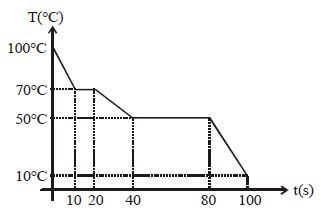
A substance is cooled at a constant power. Its temperature vs time graph is shown. The value of $S_{solid} : S_{liquid} : S_{gas}$
Two ideal Carnot engines operate in cascade (all heat given up by one engine is used by the other engine to produce work) between temperatures, $\mathrm{T}_{1}$ and $\mathrm{T}_{2} .$ The temperature of the hot reservoir of the first engine is $\mathrm{T}_{1}$ and the temperature of the cold reservoir of the second engine is $\mathrm{T}_{2} . T$ is temperature of the sink of first engine which is also the source for the second engine. How is $T$ related to $\mathrm{T}_{1}$ and $\mathrm{T}_{2}$, if both the engines perform equal amount of work?
A certain amount of gas is taken through a cyclic process $(A\,B\,C\,D\,A)$  that has two isobars, one isochore and one isothermal. The cycle can be represented on a $P-V$ indicator diagram as
A force $\vec F\, = \,(2\hat i\, - \,\hat j\, + 3\hat k)$ is acting at a point $(-1, 2, -3).$ Find its torque about the origin
A particle of mass $m$ is moving in a circular path of constant radius $r$ such that its centripetal acceleration ${a_c}$ is varying with time t as, ${a_c} = {k^2}r{t^2}$, The power delivered to the particle by the forces acting on it is
An engine pumps water continuously through a hose. Water leaves the hose with velocity $v$ and $m$ is mass per unit length of the water jet. If this jet hits a surface and came to rest instantaneously, the force on the surface is
A body covers first one-third of the distance with a velocity $20\, ms^{-1}$, the second one-third with a velocity of $30\, ms^{-1}$ and last one-third with a velocity of $40\, ms^{-1}$. The average velocity is nearly........$m/s$
Starting from the rest, at the same time, a ring, a coin and a solid ball of same mass roll down an incline without slipping .The ratio of their translational kinetic energies at the bottom will be
Which scientific principle is 'electric generator' based on: