MCQ
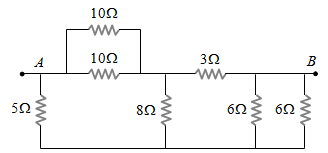
Seven resistances are connected as shown in the figure.  The equivalent resistance between $A$ and $B$ is
  • A
    $3 \Omega$
  • $4 \Omega$
  • C
    $4.5 \Omega$
  • D
    $5 \Omega$

Answer

Correct option: B.
$4 \Omega$
$4 \Omega$

Need a full question paper?

Generate a complete, print-ready paper with questions like this in minutes — across 16+ boards, with answer keys.
Start Generating Free

Similar questions

The ratio of intensities of two waves are given by 4 : 1. The ratio of the amplitudes of the two waves is(a) 2 : 1(b) 1 : 2(c) 4 : 1(d) 1 : 4
       
γ-rays radiation can be used to create electron-positron pair. In this process of pair production, γ-rays energy cannot be less than(a) 5.0 MeV(b) 4.02 MeV(c) 15.0 MeV(d) 1.02 MeV
       
The capacitance of a parallel plate condenser does not depend on(a) Area of the plates(b) Medium between the plates(c) Distance between the plates(d) Metal of the plates
   
   
Interference was observed in interference chamber when air was present, now the chamber is evacuated and if the same light is used, a careful observer will see(a) No interference(b) Interference with bright bands(c) Interference with dark bands(d) Interference in which width of the fringe will be slightly increased


According to Bohr’s theory of H atom, an electron can revolve around a proton indefinitely, if its path is:
Unit of relative permeability is:
An object of size 7.5 cm is placed in front of a convex mirror of radius of curvature 25 cm at a distance of 40 cm The size of the image should be(a) 2.3 cm(b) 1.78 cm(c) 1 cm(d) 0.8 cm
       
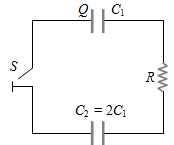
Two capacitors $C_1$ and $C_2 = 2C_1$ are connected in a circuit with a switch between them as shown in the figure. Initially the switch is open and $C_1$ holds charge $Q.$ The switch is closed. At steady state, the charge on each capacitor will be
The wave theory of light was given by(a) Maxwell(b) Planck(c) Huygen(d)  Young
       
At room temperature, a P-type semiconductor has(a) Large number of holes and few electrons(b) Large number of free electrons and few holes(c) Equal number of free electrons and holes(d) No electrons or holes