MCQ
Shape of the molecules is decided by:
- A$\sigma$-bond
- B$\pi$-bond
- CBoth $\sigma$ and $\pi$ bonds
- DNeither $\sigma$ nor $\pi$ bond
Explanation:
The reason that $\sigma$ bonds ( and lone pairs) determine the geometry is that they form the basic skeleton of the molecule, $\sigma$ bonds are formed by head-on overlap of atomic orbitals, meaning that they are oriented a long the imaginery axis connecting two atomic nuclei, and hence concentrate electron density in the region directly between the nuclei, $\pi$ bonds, on the other hand, are essentially orthogonal to the $\sigma$ bond skeleton, and are substantially weaker.
Moreover, $\pi$ bonds do not exist in isolation, meaning any $\pi$ bond between two given atoms is always formed secondarily to the $\sigma$ bond between said atoms.
As such, $\pi$ bonds do not alter the basic idealized geometry of a molecule as dictated by $\sigma$ bonding.
Generate a complete, print-ready paper with questions like this in minutes — across 16+ boards, with answer keys.
$2s$ $2{p_x}$ $2{p_y}$ $2{p_z}$

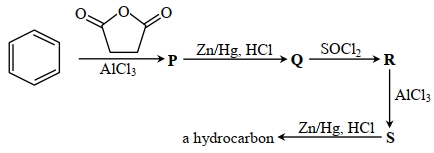
$(A)$ Compounds $P$ and $Q$ are carboxylic acids.
$(B)$ Compound $S$ decolorizes bromine water.
$(C)$ Compounds $P$ and $S$ react with hydroxylamine to give the corresponding oximes.
$(D)$ Compound $R$ reacts with dialkylcadmium to give the corresponding tertiary alcohol.