Question
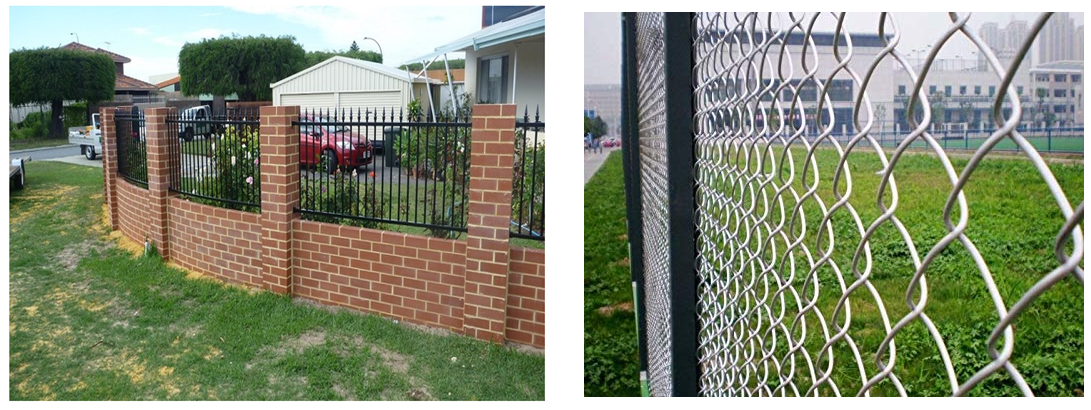
Shobhit's father wants to construct a rectangular garden using a brick wall on one side of the garden and wire fencing for the other three sides as shown in figure. He has $200$ ft of wire fencing.
Based on the above information, answer the following questions.
  1. To construct a garden using $200$ ft of fencing, we need to maximise its.
  1. Volume
  2. Area
  3. Perimeter
  4. Length of the side
  1. If x denote the length of side of garden perpendicular to brick wall and y denote the length of side parallel to brick wall, then find the relation representing total amount of fencing wire.
  1. $x + 2y = 150$
  2. $x + 2y = 50$
  3. $y + 2x = 200$
  4. $y + 2x = 100$
  1. Area of the garden as a function of $x$, say $A(x),$ can be represented as.
  1. $200 + 2x^2$
  2. $x - 2x^2$
  3. $200x - 2x^2$
  4. $200 - x^2$
  1. Maximum value of $A(x)$ occurs at $x$ equals.
  1. $50$ ft
  2. $30$ ft
  3. $26$ ft
  4. $31$ ft
  1. Maxi mum area of garden will be.
  1. $2500$ sq. ft
  2. $4000$ sq. ft
  3. $5000$ sq. ft
  4. $6000$ sq. ft

Answer

  1. (b) Area
Solution:
To create a garden using $200$ ft fencing, we need to maximise its area.
  1. (c) $y + 2x = 200$
Solution:
Required relation is given by $2x + y = 200.$
  1. (c) $200x - 2x^2$
Solution:
Area of garden as a function of x can be rep resented as
$A(x) = x·y = x(200 - 2x) = 200x - 2x^2$
  1. (a) $50$ ft
Solution:
$A(x) = 200x - 2x^2 \Rightarrow A'(x) = 200 - 4x$
For the area to be maximum $A'(x) = 0$
$⇒ 200 - 4x =0$
$⇒ x = 50$ ft
  1. (c) $5000$ sq. ft
Solution:
Maximum area of the garden $= 200(50) - 2(50)^2 = 10000 - 5000 = 5000$ sq. ft

Need a full question paper?

Generate a complete, print-ready paper with questions like this in minutes — across 16+ boards, with answer keys.

Start Generating Free

Similar questions

Akash and Prakash appeared for first round of an interview for two vacancies. The probability of Nisha's selection is $\frac{1}{3}$ and that of Ayushi's selection is $\frac{1}{2}$.

Image

(i) Find the probability that both of them are selected.

(ii) The probability that none of them is selected.

In a wedding ceremony, consists of father, mother, daughter and son line up at random for a family photograph, as shown in figure.
Based on the above information, answer the following questions.
  1. Find the probability that daughter is at one end, given that father and mother are in the middle.
  1. $1$
  2. $\frac{1}{2}$
  3. $\frac{1}{3}$
  4. $\frac{2}{3}$
  1. Find the probability that mother is at right end, given that son and daughter are together.
  1. $\frac{1}{2}$
  2. $\frac{1}{3}$
  3. $\frac{1}{4}$
  4. $0$
  1. Find the probability that father and mother are in the middle, given that son is at right end.
  1. $\frac{1}{4}$
  2. $\frac{1}{2}$
  3. $\frac{1}{3}$
  4. $\frac{2}{3}$
  1. Find the probability that father and son are standing together, given that mother and daughter are standing together.
  1. $0$
  2. $1$
  3. $\frac{1}{2}$
  4. $\frac{2}{3}$
  1. Find the probability that father and mother are on either of the ends, given that son is at second position from the right end.
  1. $\frac{1}{3}$
  2. $\frac{2}{3}$
  3. $\frac{1}{4}$
  4. $\frac{2}{5}$
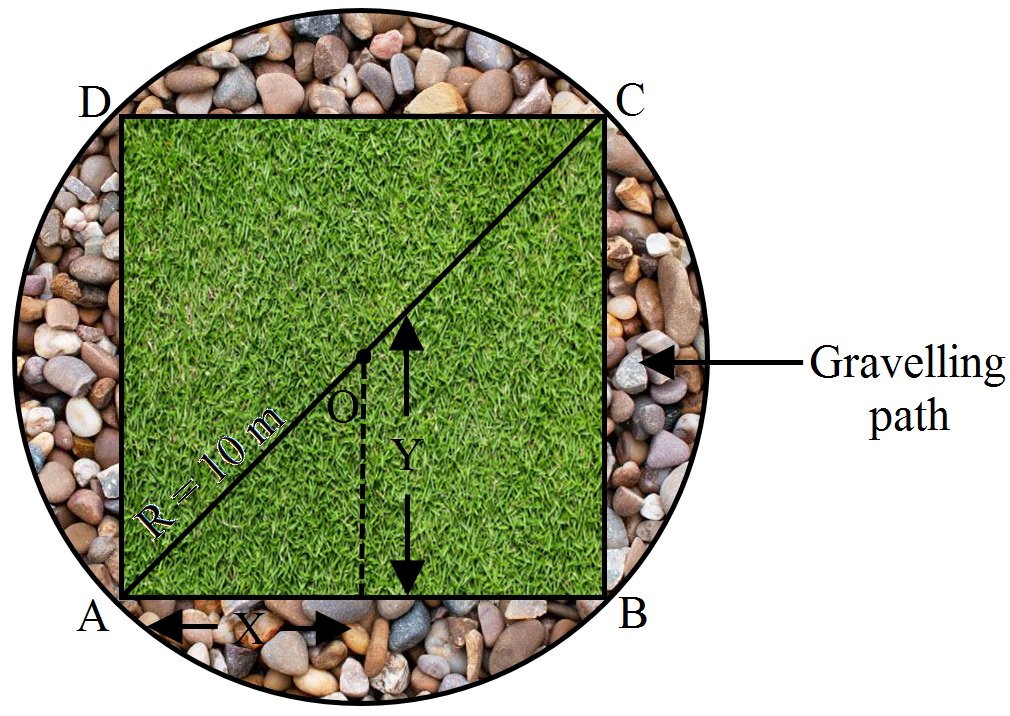
In a society there is a garden in the shape of rectangle inscribed in a circle of radius 10m as shown in given figure.

Based on the above information, answer the following questions.
  1. If $2x$ and $2y$ denotes the length and breadth in metres, of the rectangular part, then the relation between the variables is.
  1. $x^2 - y^2 = 10$
  2. $x^2 + y^2 = 10$
  3. $x^2 + y^2 = 100$
  4. $x^2 - y^2 = 100$
  1. The area $(A)$ of green grass, in terms of $x,$ is given by.
  1. $2\text{x}\sqrt{100-\text{x}^2}$
  2. $4\text{x}\sqrt{100-\text{x}^2}$
  3. $2\text{x}\sqrt{100+\text{x}^2}$
  4. $4\text{x}\sqrt{100+\text{x}^2}$
  1. The maximum value of $A$ is.
  1. $100\text{m}^2$
  2. $200\text{m}^2$
  3. $400\text{m}^2$
  4. $1600\text{m}^2$
  1. The value of length of rectangle, when $A$ is maximum, is.
  1. $10\sqrt{2}\text{m}$
  2. $20\sqrt{2}\text{m}$
  3. $20\text{m}$
  4. $5\sqrt{2}\text{m}$
  1. The area of gravelling path is.
  1. $100(\pi+2)\text{m}^2$
  2. $100(\pi-2)\text{m}^2$
  3. $200(\pi+2)\text{m}^2$
  4. $200(\pi-2)\text{m}^2$
If the equation is of the form $\frac{\text{dy}}{\text{dx}}=\text{py}=\text{Q},$ where P, Q are functions of x, then the solution of the differential equation is given by $\text{ye}^{\int\text{pdx}}=\int\text{Q e}^{\int\text{pdx}}\text{dx}+\text{c},$ where $\text{e}^{\int\text{pdx}}$ is called the integrating factor (I.F.).
Based on the above information, answer the following questions.
  1. The integrating factor of the differential equation $\sin\text{x}\frac{\text{dy}}{\text{dx}}+2\text{y}\cos\text{x}=1$ is $(\sin\text{x})^\lambda,$ where $\lambda=$
  1. 0
  2. 1
  3. 2
  4. 3
  1. Integrating factor of the differential equation $(1-\text{x}^2)\frac{\text{dy}}{\text{dx}}-\text{xy}=1$ is:
  1. $-\text{x}$
  2. $\frac{\text{x}}{1+\text{x}^2}$
  3. $\sqrt{1-\text{x}^2}$
  4. $\frac{1}{2}\log(1-\text{x}^2)$
  1. The solution of $\frac{\text{dy}}{\text{dx}}+\text{y}=\text{e}^{-\text{x}},\text{ y}(0)=0,$ is:
  1. $\text{y}=\text{e}^\text{x}(\text{x}-1)$
  2. $\text{y}=\text{xe}^{-\text{x}}$
  3. $\text{y}=\text{xe}^{-\text{x}}+1$
  4. $\text{y}=(\text{x}+1)\text{e}^{-\text{x}}$
  1. General solution of $\frac{\text{dy}}{\text{dx}}+\text{y}\tan\text{x}=\sec\text{x}$ is:
  1. $\text{y}\sec\text{y}=\tan\text{x}+\text{c}$
  2. $\text{y}\tan\text{x}=\sec\text{x}+\text{c}$
  3. $\tan\text{x}=\text{y}\tan\text{x}+\text{c}$
  4. $\text{x}\sec\text{x}=\tan\text{y}+\text{c}$
  1. The integrating factor of differential equation $\frac{\text{dy}}{\text{dx}}-3\text{y}=\sin2\text{x}$ is:
  1. $\text{e}^{3\text{x}}$
  2. $\text{e}^{-2\text{x}}$
  3. $\text{e}^{-3\text{x}}$
  4. $\text{xe}^{-3\text{x}}$
Read the following text carefully and answer the questions that follow:
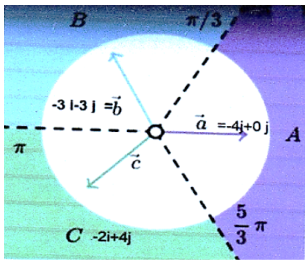
Three friends Ganesh, Dinesh and Ramesh went for playing a Tug of war game. Team $A, B,$ and $C$ belong to Ganesh, Dinesh and Ramesh respectively.
Teams $A, B, C$ have attached a rope to a metal ring and is trying to pull the ring into their own area $($team areas shown below$)$.
Team $A$ pulls with $F _1=4 \hat{i}+0 \hat{j} KN$
Team $B \rightarrow F _2=-2 \hat{i}+4 \hat{j} KN$
Team $C \rightarrow F _3=-3 \hat{i}-3 \hat{j} KN$
Image
$i$. Which team will win the game? $(1)$
$ii$. What is the magnitude of the teams combine Force? $(1)$
$iii.$  What is the magnitude of the force of Team $B? (2)$
OR
How many $KN$ Force is applied by Team $A? (2)$
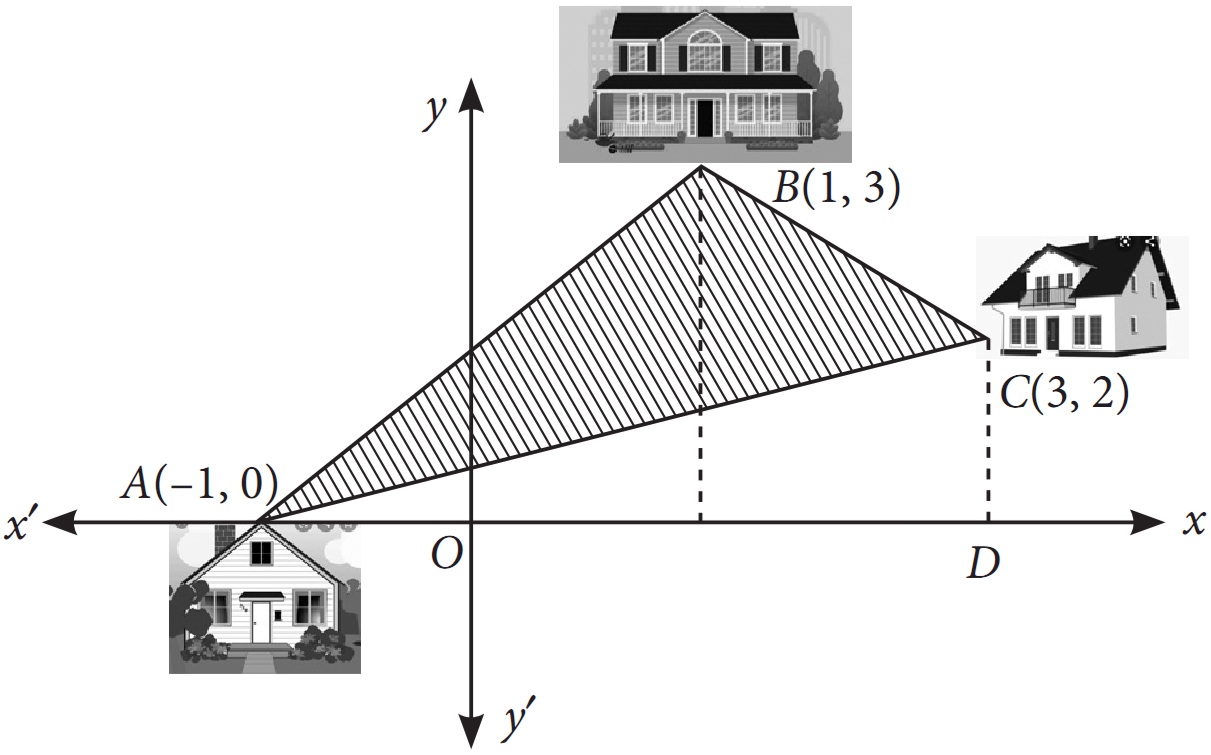
Location of three houses of a society is represented by the points A(-1, 0), B(1, 3) and C(3, 2) as shown in figure.

Based on the above information, answer the following questions
  1. Equation of line AB is.
    1. $\text{y}=\frac{3}{2}(\text{x}+1)$
    2. $\text{y}=\frac{3}{2}(\text{x}-1)$
    3. $\text{y}=\frac{1}{2}(\text{x}+1)$
    4. $\text{y}=\frac{1}{2}(\text{x}-1)$
  2. Equation of line BC is.
    1. $\text{y}=\frac{1}{2}\text{x}-\frac{7}{2}$
    2. $\text{y}=\frac{3}{2}\text{x}-\frac{7}{2}$
    3. $\text{y}=\frac{-1}{2}\text{x}+\frac{7}{2}$
    4. $\text{y}=\frac{3}{2}\text{x}+\frac{7}{2}$
  3. Area of region ABCD is.
  1. 2 sq. units
  2. 4 sq. units
  3. 6 sq. units
  4. 8 sq. units
  1. Area of $\triangle\text{ADC}$ is,
  1. 4 sq. units
  2. 8 sq. units
  3. 16 sq. units
  4. 32 sq. units
  1. Area of $\triangle\text{ABC}$ is.
  1. 3 sq. units
  2. 4 sq. units
  3. 5 sq. units
  4. 6 sq. units
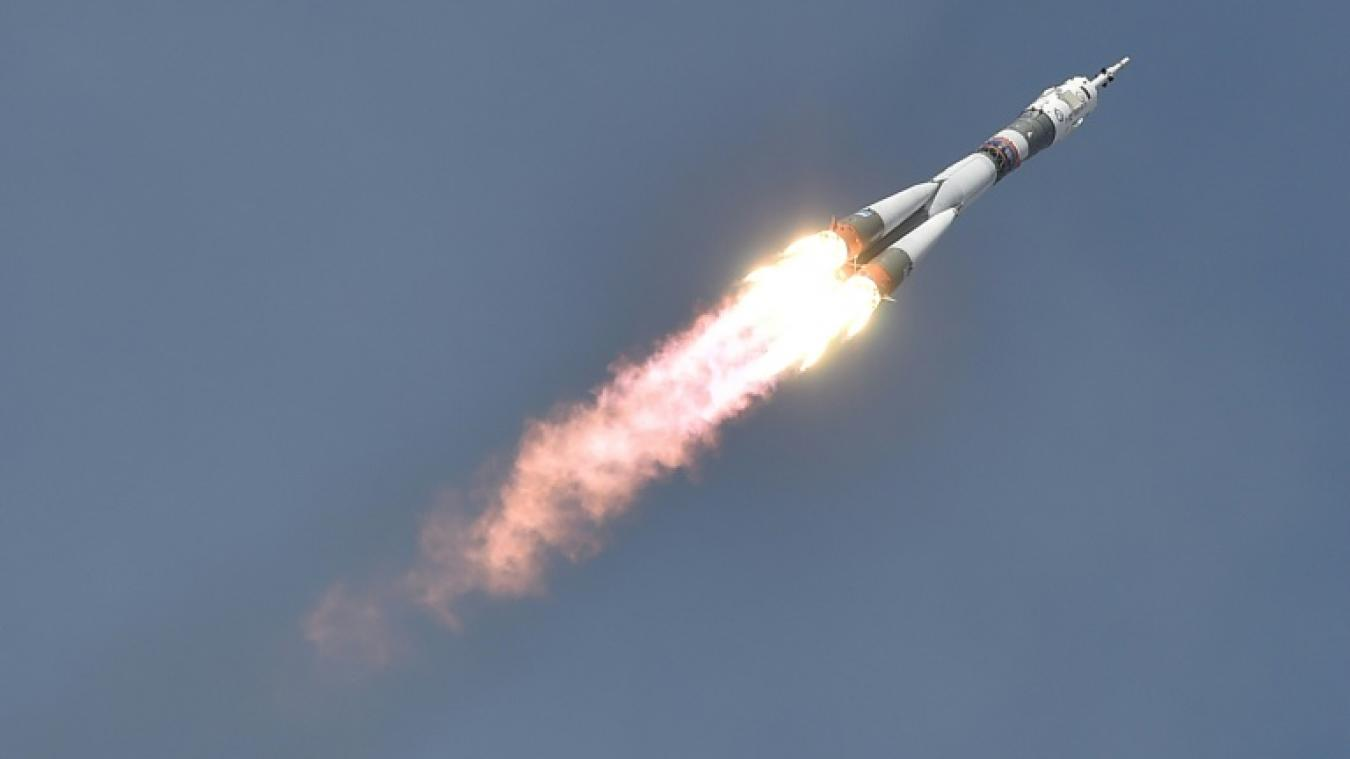
The upward speed v(I) of a rocket at time I is approximated by $\text{v}(\text{t})=\text{at}^2+\text{bt}+\text{c},0\leq\text{t}\leq100,$ here $a, b$ and $c$ are constants. It has been found that the speed at times $t = 3, t = 6$ and $t = 9$ seconds are respectively $64, 133$ and $208$ miles per second..

If $\begin{bmatrix}9&3&1\\36&6&1\\81&9&1\end{bmatrix}^{-1}=\frac{1}{18}\begin{bmatrix}1&-2&1\\-15&24&-9\\54&-54&18\end{bmatrix},$ then answer the following questions.
  1. The value of $b + c$ is:
  1. $20$
  2. $21$
  3. $\frac{3}{4}$
  4. $\frac{4}{3}$
  1. The value of $a + c$ is:
  1. $1$
  2. $20$
  3. $\frac{4}{3}$
  4. None of these.
  1. v(t) is given by:
  1. $\text{t}^2+20\text{t}+1$
  2. $\frac{1}{3}\text{t}^2+20\text{t}+1$
  3. $\text{t}^2+\frac{1}{3}\text{t}+20$
  4. $\text{t}^2+\text{t}+1$
  1. The speed at time $1 = 15$ seconds is:
  1. $346$ miles/ sec
  2. $356$ miles/ sec
  3. $366$ miles/ sec
  4. $376$ miles/ sec
  1. The time at which the speed of rocket is $784$ miles/ sec is:
  1. $20$ seconds
  2. $30$ seconds
  3. $25$ seconds
  4. $27$ seconds
Corner points of the feasible region for an LPP are (0, 3), (5, 0), (6, 8), (0, 8). Let Z = 4x - 6y be the objective function.
Based on the above information, answer the following questions.
  1. The minimum value of Z occurs at:
  1. (6, 8)
  2. (5, 0)
  3. (0, 3)
  4. (0, 8)
  1. Maximum value of Z occurs at:
  1. (5, 0)
  2. (0, 8)
  3. (0, 3)
  4. (6, 8)
  1. Maximum of Z - Minimum of Z =
  1. 58
  2. 68
  3. 78
  4. 88
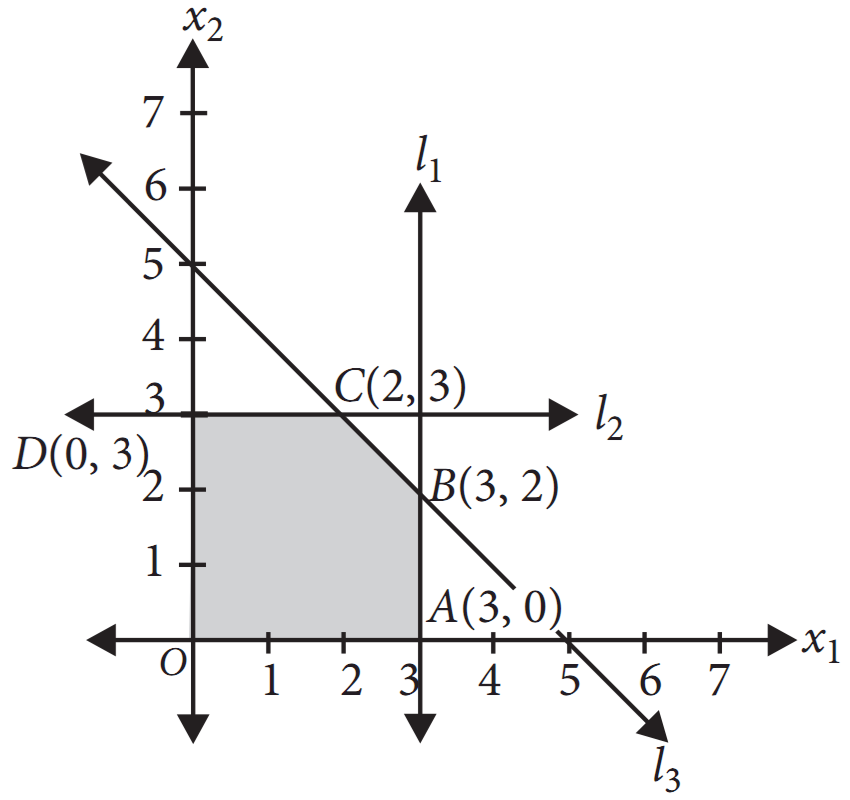
  1. The corner points of the feasible region determined by the system of linear inequalities are:
  1. (0, 0), (-3, 0), (3, 2). (2, 3)
  2. (3, 0), (3, 2), (2, 3), (0, -3)
  3. (0, 0), (3, 0), (3, 2), (2, 3), (0, 3)
  4. None of these
  1. The feasible solution of LPP belongs to:
  1. First and second quadrant.
  2. First and third quadrant.
  3. Only second quadrant.
  4. Only first quadrant.
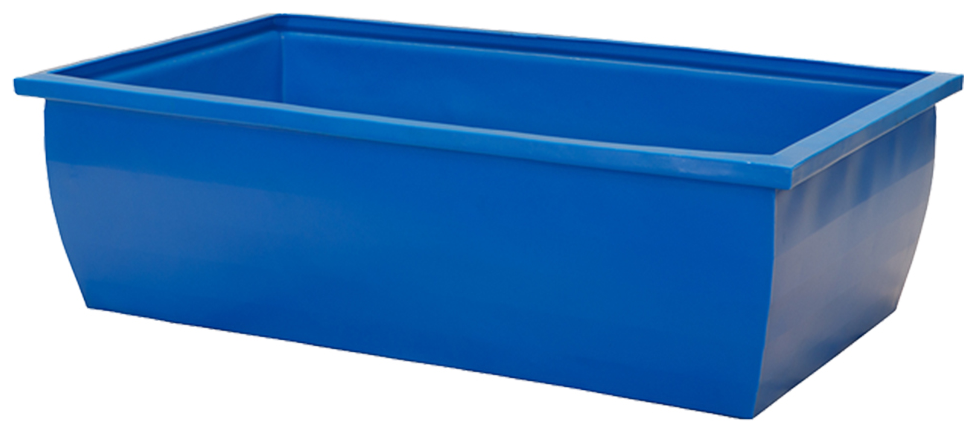
Nitin wants to construct a rectangular plastic tank for his house that can hold $80\ ft^3$ of water. The top of the tank is open. The width of tank will be $5$ ft but the length and heights are variables. Building the tank cost$?\ ₹ 20$ per sq. foot for the base and $₹\ 10$ per sq. foot for the side.

Based on the above information, answer the following questions.
  1. In order to make a least expensive water tank, Nitin need to minimize its.
  1. Volume
  2. Base
  3. Curved surface area
  4. Cost
  1. Total cost of tank as a function of h can be represented as.
  1. $c(h) = 100h - 320 - 1600/ h$
  2. $c(h) = 100h - 320h - 720h^2$
  3. $c(h) = 100 + 320h + 1600h^2$
  4. $\text{c}\big(\text{h}\big)=100\text{h}+320+\frac{1600}{\text{h}}$
  1. Range of $h$ is.
  1. $(3, 5)$
  2. $\big(0,\infty\big)$
  3. $(0, 8)$
  4. $(0, 3)$
  1. Value of hat which $c(h)$ is minimum, is.
  1. $4$
  2. $5$
  3. $6$
  4. $6, 7$
  1. The cost of least expensive tank is.
  1. $₹\ 1020$
  2. $₹\ 1100$
  3. $₹\ 1120$
  4. $₹\ 1220$
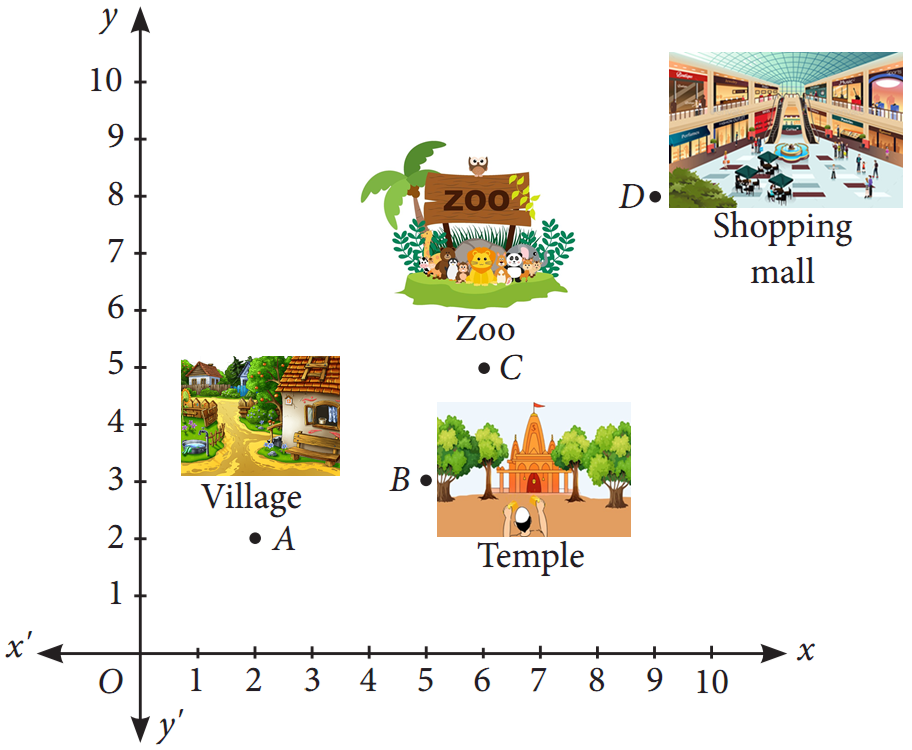
Ishaan left from his village on weekend. First, he travelled up to temple. After this, he left for the zoo. After this, he left for shopping in a mall. The positions of Jshaan at different places is given in the following graph.

Based on the above information, answer the following questions.
  1. Position vector of B is:
  1. $3\hat{\text{i}}+5\hat{\text{j}}$
  2. $5\hat{\text{i}}+3\hat{\text{j}}$
  3. $-5\hat{\text{i}}-3\hat{\text{j}}$
  4. $-5\hat{\text{i}}+3\hat{\text{j}}$
  1. Position vector of D is:
  1. $5\hat{\text{i}}+3\hat{\text{j}}$
  2. $3\hat{\text{i}}+5\hat{\text{j}}$
  3. $8\hat{\text{i}}+9\hat{\text{j}}$
  4. $9\hat{\text{i}}+8\hat{\text{j}}$
  1. Find the vector $\overline{\text{BC}}$ in terms of $\hat{\text{i}},\hat{\text{j}}.$
  1. $\hat{\text{i}}-2\hat{\text{j}}$
  2. $\hat{\text{i}}+2\hat{\text{j}}$
  3. $2\hat{\text{i}}+\hat{\text{j}}$
  4. $2\hat{\text{i}}-\hat{\text{j}}$
  1. Length of vector $\overline{\text{AB}}$ is:
  1. $\sqrt{67}\text{ units}$
  2. $\sqrt{85}\text{ units}$
  3. 90 units
  4. 100 units
  1. If $\vec{\text{M}}=4\hat{\text{j}}+3\hat{\text{k}},$ then its unit vector is:
  1. $\frac{4}{5}\hat{\text{j}}+\frac{3}{5}\hat{\text{k}}$
  2. $\frac{4}{5}\hat{\text{j}}-\frac{3}{5}\hat{\text{k}}$
  3. $-\frac{4}{5}\hat{\text{j}}+\frac{3}{5}\hat{\text{k}}$
  4. $-\frac{4}{5}\hat{\text{j}}-\frac{3}{5}\hat{\text{k}}$