Question
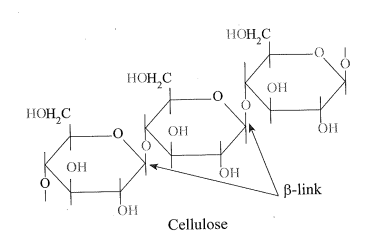
Short note on : Cellulose.
Answer

$\rightarrow$ Cellulose occurs exclusively in plants and it is the most abundant organic substance in plant kingdom.
$\rightarrow$ It is a predominant constituent of cell wall of plant cells.
Cellulose is a straight chain polysaccharide composed only of $ẞ-D-$glucose units which $\rightarrow$ are joined by glycosidic linkage between $C_1$ of one glucose unit and $C_4$ of the next glucose unit.
Image

Need a full question paper?

Generate a complete, print-ready paper with questions like this in minutes — across 16+ boards, with answer keys.

Start Generating Free

Similar questions

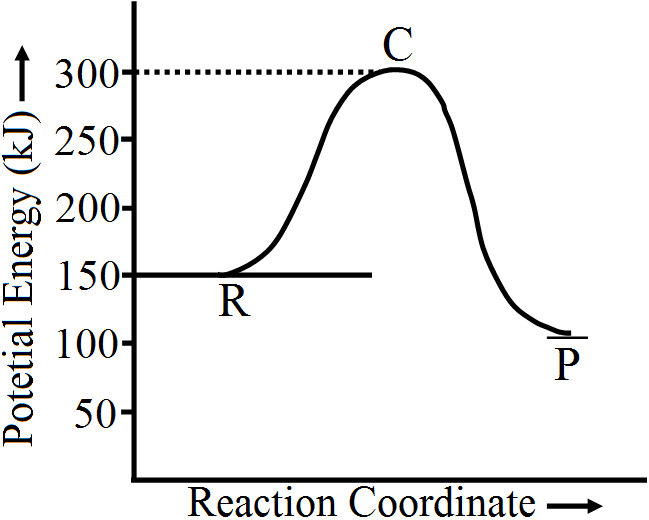
Answer the following questions on the basis of the given plot of potential energy vs reaction coordinate:
  1. What is the threshold energy for the reaction?
  2. What is the activation energy for forward reaction?
  3. What is the activation energy for backward reaction?
  4. What is enthalpy change for the forward reaction?
Image
In the above reaction sequence, write the chemical formula and IUPAC name of X and Y.
Explain the following giving an appropriate reason in each case.
  1. $O_2$ and $F_2$ both stabilise higher oxidation states of metals but $O_2$ exceeds $F_2$ in doing so.
  2. Structures of Xenon fluorides cannot be explained by Valence Bond approach.
How many Coulomb charge is required to obtain one mole of Al from $Al ^{3+}$ ?
What are the characteristics of the transition elements and why are they called transition elements? Which of the d-block elements may not be regarded as the transition elements?
State Raoult’s law for solutions of volatile liquid components. Taking a suitable example, explain the meaning of positive deviation from Raoult’s law.
Answer the following:
  1. Which neutral molecule would be isoelectronic with $CIO^–?$
  2. Of $Bi(V)$ and $Sb(V)$ which may be a stronger oxidising agent and why?
Explain the following with suitable examples:
Paramagnetism.

Match the reactions given in Column I with the names given in Column II.
  Column I   Column II
(i) (a) Fittig reaction
(ii) (b) Wurtz Fittig reaction
(iii) (c) Finkelstein reaction
(iv) (d) Sandmeyer reaction
Explain the following term with suitable examples:
Interstitials.