Question
Short Note on dry cell ### Explain Leclanche cell.

Answer

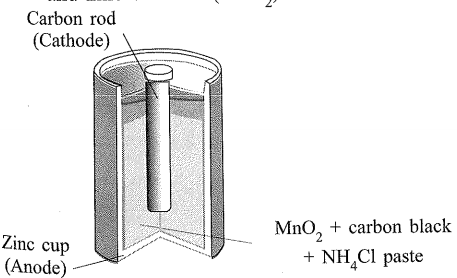
→ The cell consists of a zinc container that also acts as anode, while the cathode is a carbon (graphite) rod surrounded by powered manganese dioxide and carbon.
→ The space between the electrodes is filled with a moist of paste of ammonium chloride $\left( NH _4 Cl \right)$ and zinc chloride $\left( ZnCl _2\right)$
Image
→ Dry cells are often used in devices like transistors, toys and clocks.
→ The electrode reactions are complex, by they can be written approximately as follows :
Anode $: Zn ( s ) \rightarrow Zn ^{2+}+2 e ^{-}$
Cathode : $MnO _2+ NH _4^{+}+ e ^{-} \rightarrow MnO ( OH )+ NH _3$
→ In the reaction at cathode, manganese is reduced from the +4 oxidation state to the +3 state.
→ Ammonia produced in the reaction forms a complex with $Zn ^{+2}$ to give $\left[ Zn \left( NH _3\right)_4\right]^{+2}$. The cell has a potential of nearly 1.5 V .

Need a full question paper?

Generate a complete, print-ready paper with questions like this in minutes — across 16+ boards, with answer keys.
Start Generating Free

Similar questions

Answer the following questions:
An optically active compound having molecular formula C7H15Br reacts with aqueous KOH to give a racemic mixture of products. Write the mechanism involved in this reaction.
Write short note on alloys.
Answer the following questions:
In the titration of FeSO4 with KMnO4 in the acidic medium, why is dil. H2SO4 used instead of dil. HCl?
Explain with chemical reactions, the formation of anhydrides and esters from carboxylic acids.
Aqueous copper sulphate solution and aqueous silver nitrate solution are electrolysed by 1 ampere current for 10 minutes in separate electrolytic cells. Will the mass of copper and silver deposited on the cathode be same or different? Explain your answer.
Indicate the types of isomerism exhibited by the following complexes and draw the structures for these isomers:
  1. [Pt(NH3)(H2O)Cl2].
  2. K[Cr(H2O)2(C2O4)2].
A 4% solution(w/ w) of sucrose (M = 342g mol-1) in water has a freezing point of 271.15K. Calculate the freezing point of 5% glucose (M = 180g mol-1) in water.
(Given: Freezing point of pure water = 273.15 K)
Write down the IUPAC name for the following complex and indicate the oxidation state, electronic configuration and coordination number. Also give stereochemistry and magnetic moment of the complex:
K4[Mn(CN)6]
The conductivity of 0.001028 mol L-1 acetic acid is 4.95 × 10⁻⁵ S cm-1. Calculate its dissociation constant $\Lambda^{\circ}_{\text{m}}$ if for acetic acid is 390.5 S cm2 mol-1.
Determine the formula for the half life of a first order reaction and prove that the half life of a first order reaction does not depends on the initial concentration of the reactant.