Question
Short Note on dry cell ### Explain Leclanche cell.

Answer

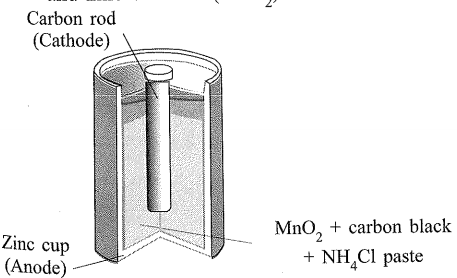
→ The cell consists of a zinc container that also acts as anode, while the cathode is a carbon (graphite) rod surrounded by powered manganese dioxide and carbon.
→ The space between the electrodes is filled with a moist of paste of ammonium chloride $\left( NH _4 Cl \right)$ and zinc chloride $\left( ZnCl _2\right)$
Image
→ Dry cells are often used in devices like transistors, toys and clocks.
→ The electrode reactions are complex, by they can be written approximately as follows :
Anode $: Zn ( s ) \rightarrow Zn ^{2+}+2 e ^{-}$
Cathode : $MnO _2+ NH _4^{+}+ e ^{-} \rightarrow MnO ( OH )+ NH _3$
→ In the reaction at cathode, manganese is reduced from the +4 oxidation state to the +3 state.
→ Ammonia produced in the reaction forms a complex with $Zn ^{+2}$ to give $\left[ Zn \left( NH _3\right)_4\right]^{+2}$. The cell has a potential of nearly 1.5 V .

Need a full question paper?

Generate a complete, print-ready paper with questions like this in minutes — across 16+ boards, with answer keys.
Start Generating Free

Similar questions

What is the difference between Galvanic cell (Electrochemical cell) and Electrolytic cell.
The first order rate constant for the decomposition of ethyl iodide by the reaction
C2H5I(g) → C2H4(g) + HI(g)
at 600 K is 1.60 × 10⁻² s-1. Its energy of activation is 209 kJ/mol. Calculate the rate constant of the reaction at 700 Κ.
Write the reactions taking place at the anode and cathode in the above cell.
Following data are obtained for the reaction:
N2O5 $\rightarrow$ 2NO2 + ½O2
t/s 0 300 600
[N2O5]/mol L–1 1.6 × 10⁻² 0.8 × 10⁻² 0.4 × 10⁻²
  1. Show that it follows first order reaction.
  2. Calculate the half-life.
(Given log 2 = 0.3010 log 4 = 0.6021)
Discuss in details the oxidation of methyl ketones by haloform reaction. And also mention that for detection of which type of group this reaction is useful?
Write structures of compounds A, B and C in each of the following reactions:
  1. $ \text{C}_6\text{H}_5\text{Br}\xrightarrow{\text{Mg/dry ether}}\text{A}\xrightarrow[(b )\text{ }\text{H}_3\text{O}^+]{(a)\text{ }\text{Co}_{2\text{(g)}}}\text{B}\xrightarrow{\text{PC}l_5}\text{C}$
  2. $ \text{C}\text{H}_3\text{CN}\xrightarrow[(b )\text{ }\text{H}_3\text{O}^+]{(a)\text{ }\text{SnC}l_{2}/\text{HC}l}\text{A}\xrightarrow{\text{dil.NaOH}}\text{B}\xrightarrow{\text{ }\text{ }\text{ }\text{ }\text{ }\triangle\text{ }\text{ }\text{ }\text{ }\text{ }\text{ }\text{ }\text{ }}\text{C}$
What happens when
i. n-butyl chloride is treated with alcoholic KОН.
ii. bromobenzene is treated with Mg in the presence of dry ether.
iii. chlorobenzene is subjected to hydrolysis.
An organic compound with the molecular formula $C _9 H _{10} O$ forms 2,4-DNP derivative, reduces Tollens' reagent and undergoes Cannizzaro reaction. On vigorous oxidation it gives 1,2-benzene dicarboxylic acid. Identify the compound.
Give reactions taking place at the two electrodes if these are made up of Ag.
What are alloys? Name an important alloy which contains some of the lanthanoid metals. Mention its uses.