Question
Short note on: Maltose

Answer

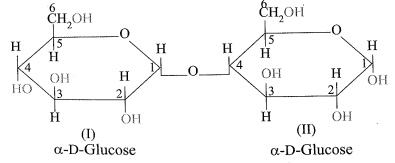
$\rightarrow$ Maltose is composed of two $a-D-$glucose.
$\rightarrow $ ​​​​​​​
Image
$\rightarrow$ In maltose $C_1$ of one glucose $(I)$ is linked to $C_4$ of another glucose unit $(II).$
$\rightarrow$ The free aldehyde group can be produced at $C_1$ of second glucose in solution and it shows reducing properties
​​​​​​​so, it is a reducing sugar.​​​​​​​
Image

Need a full question paper?

Generate a complete, print-ready paper with questions like this in minutes — across 16+ boards, with answer keys.

Start Generating Free

Similar questions

Write the chemical reactions involved in the process of extraction of Gold. Explain the role of dilute NaCN and Zn in this process.
Discuss applications of d and $f-$Block element.
Write electrode reactions taking place in:
  1. Ni–Cd cell.
  2. Lead Acid Accumulator.
Calculate the emf of the following cell at $25^{\circ} C$.$Fe \left| Fe ^{2+}(0.001 M )\right|\left| H ^{+}(0.01 M )\right| H _2(g)(1 bar ) \mid Pt ( s )$
Given that, $E_{ Fe ^{2+} / Fe }^o=-0.44 V ; E_{H^{+} / H_2}^o=0.00 V$
The first order rate constant for the decomposition of ethyl iodide by the reaction
$C_2H_5I(g) \rightarrow C_2H_4(g) + HI(g)$
at $600\ K$ is $1.60 \times 10^{-2} s^{-1}$. Its energy of activation is $209\ kJ/mol.$ Calculate the rate constant of the reaction at $700 Κ.$
  1. Using valence bond theory predict the geometry and magnetic behaviour of $\ce{[Cr(NH_3)_6]^{3+ }ion[Cr=24]}.$
  2. Write $\text{IUPAC}$ name of:
$\ce{[Pt(NH_3)_2Cl_2]}.$
Preparation of ethers by acid dehydration of secondary or tertiary alcohols is not a suitable method. Give reason.
Consider a certain reaction A → Products with k = 2 × 10⁻² s-1. Calculate the concentration of A remaining after 100 s if the initial concnetration of A is 1.0 mol L-1.
  1. What type of isomerism is shown by the complex $\ce{[Co(NH_3)_5 (SCN)]^{2+}}$?
  2. Why is $\ce{[NiCl_4]^{2-}}$ paramagnetic while $\ce{[Ni(CN)_4]^{2-}}$ is diamagnetic? $($Atomic number of $Ni = 28)$
  3. Why are low spin tetrahedral complexes rarely observed?
$100\ g$ of liquid $A ($molar mass $140\ g\ mol^{–1})$ was dissolved in $1000\ g$ of liquid $B ($molar mass $180\ g\ mol^{–1}).$ The vapour pressure of pure liquid $B$ was found to be $500$ torr. Calculate the vapour pressure of pure liquid $A$ and its vapour pressure in the solution if the total vapour pressure of the solution is $475$ Torr.