Question
Show by using the graphical method that:
$\text{s}=\text{ut}+\frac{1}{2}\text{at}^2$
where the symbols have their usual meanings.
Answer

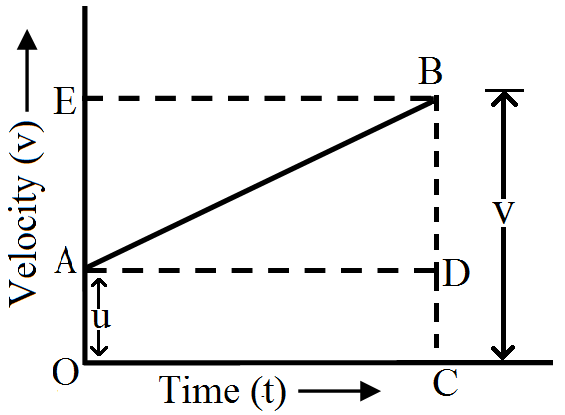
Consider the velocity-time graph of a body shown in figure. The body has an initial velocity $u$ at a point $A$ and then its velocity changes at a uniform rate from $A$ to $B$ in time $t.$ In other words, there is a uniform acceleration a from $A$ to $B,$ and after time $t$ its final velocity becomes $v$ which is equal to $BC$ in the graph. The time $t$ is represented by $OC.$

Suppose the body travels a distance $s$ in time $t.$ In the figure, the distance travelled by the body is given by the area of the space between the velocity-time graph AB and the time axis $OC,$ which is equal to the area of the figure $OABC.$ Thus:
Distance travelled $=$ Area of figure $OABC$
$=$ Area of rectangle $OABC\ +$ area of triangle $ABD$
Now, we will find out the area of rectangle $OABC$ and area of triangle $ABD.$​​​​​​​
  1. Area of rectangle $OADC = OA × OC$
$= u × t$
$= ut$
  1. Area of triangle ABD $=\Big(\frac{1}{2}\Big)\times\text{Area of rectangle AEBD}$
$=\Big(\frac{1}{2}\Big)\times\text{AD}\times\text{BD}$
$=\Big(\frac{1}{2}\Big)\text{at}^2$
Distance travelled, $s =$ Area of rectangle $OADC\ +$ Area of triangle $ABD$
$\text{s}=\text{ut}+\frac{1}{2}\text{at}^2$

Need a full question paper?

Generate a complete, print-ready paper with questions like this in minutes — across 16+ boards, with answer keys.

Start Generating Free

Similar questions

Why is AIDS considered to be a ‘Syndrome’ and not a disease$?$
A bullet of mass $15g$ has a speed of $400m/s$. What is its kinetic energy? If the bullet strikes a thick target and is brought to rest in $2cm$, calculate the average net force acting on the bullet. What happens to the kinetic energy originally in the bullet?
How will you separate common salt, sand and iron filings from their mixture?
Write a note on cattle feed.
Show by using the graphical method that:

$\text{s}=\text{ut}+\frac{1}{2}\text{at}^2$

where the symbols have their usual meanings.
An element $X$ forms the following compounds with hydrogen, carbon and oxygen: $H_2X, CX_2, XO_2, XO_3$

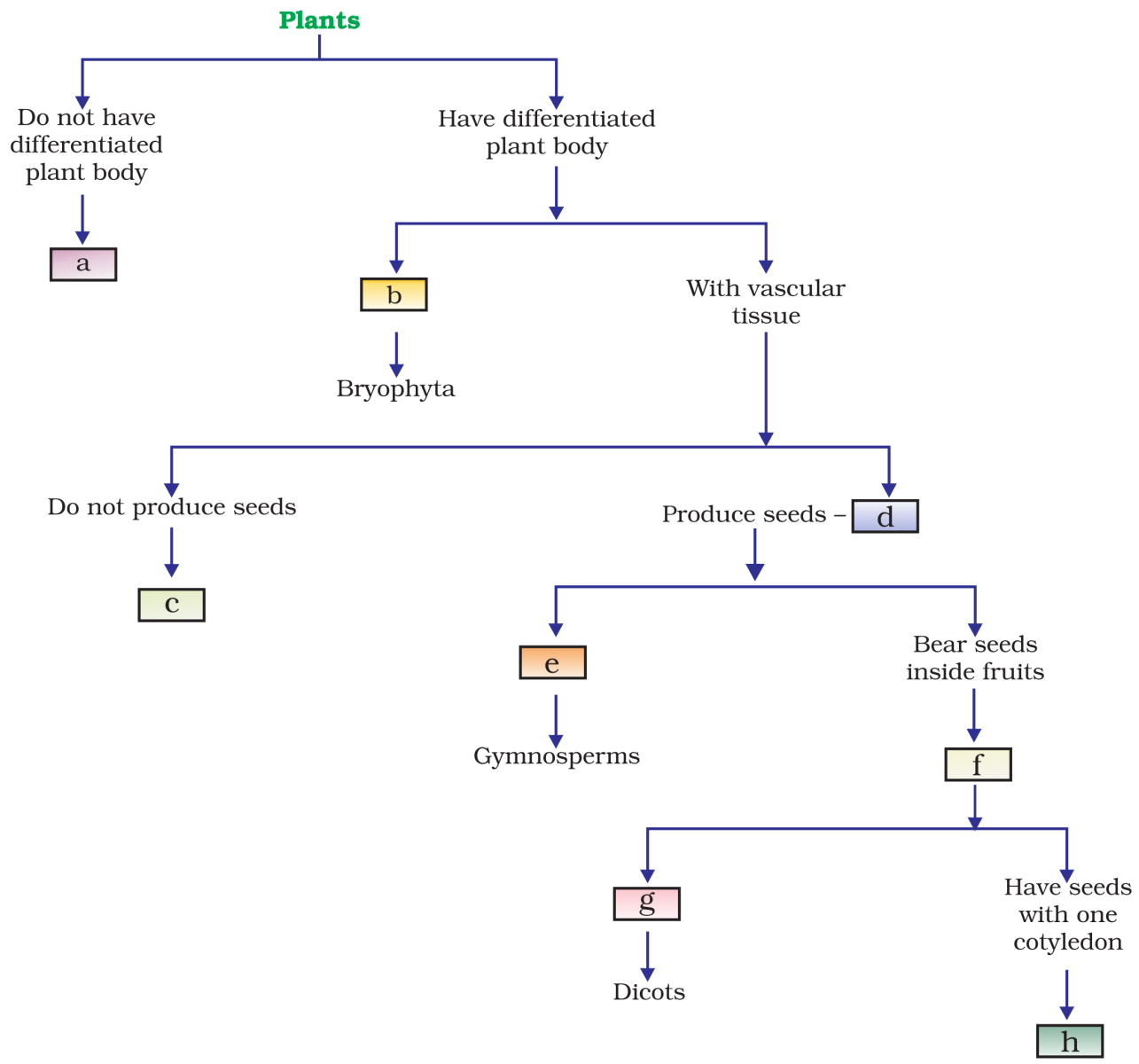
Fill in the boxes given in with appropriate characteristics/ plant group (s).
How are living organisms dependent on the soil? Are organisms that live in water totally independent of soil as a resource?
Classify the following as chemical or physical changes:
  • Cutting of trees.
  • Melting of butter in a pan.
  • Rusting of almirah.
  • Boiling of water to form steam.
  • Passing of electric current, through water and the water breaking down into hydrogen and oxygen gases.
  • Dissolving common salt in water.
  • Making a fruit salad with raw fruits.
  • Burning of paper and wood.
Three different vibrating objects produce three types of sounds $X, Y$ and $Z.$ Sounds $X$ and $Y$ cannot be heard by a man having normal range of hearing but sound $Z$ can be heard easily. The sound $X$ is used in hospitals to break kidney stones of a patient into fine grains whioch then get flushed out with urine. The sound $Y$ is similar to that which is produced during an earthquake before the main shock wave is generated.
  1. What type of sounds are $(i) X, (ii) Y,$ and $(iii) Z?$
  2. Name one device which can produce sound like $X.$
  3. Name one device in a science laboratory which can produce sound like $Y.$
  4. Name one device in our homes which can produce sound like $Z.$
  5. What is the frequency range of sounds like $Z?$