Question
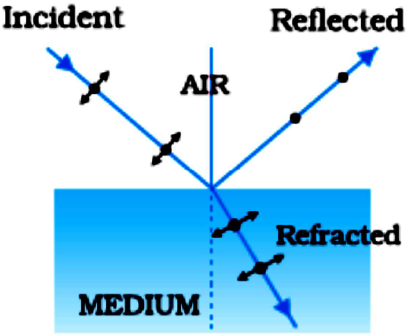
  1. Show, giving a suitable diagram, how unpolarized light can be polarised by reflection.
  2. Two polaroids P1 and P2  are placed with their pass axes perpendicular to each other. Unpolarised light of intensity Io is incident on P1 A third polaroid P3 is kept in between P1 and P2 such that its pass axis makes an angle of $60^{\circ}$with that of P1. Determine the intensity of light transmitted through P1, P2 and P3.
Answer

  1. When unpolarised light is incident on the boundary between two transparent media, the reflected light gets plane polarized with its electric vector perpendicular to the plane of incidence.

The polarization is complete when the reflected and refracted rays are at right angles to each other. This condition occurs for an angle of incidence, ip, where tan ip = $\mu$

  1. Intensity of light through $\text{P}_1=\frac{I_0}{2}$

Intensity of light through $\text{P}_2=\frac{I_0}{2}\cos^260$

$\frac{I_0}{2}.\bigg(\frac{1}{2}\bigg)^2=\frac{I_0}{8}$

Intensity of light through $ \text{P}_3=\frac{I_0}{8}\cos^230=\frac{I_0}{8}\times\bigg(\frac{\sqrt{3}}{2}\bigg)^2=\frac{3I_0}{32}$

Need a full question paper?

Generate a complete, print-ready paper with questions like this in minutes — across 16+ boards, with answer keys.

Start Generating Free

Similar questions

Pick up (i) Isotones, (ii) Isotopes, (iii) Isobars among the following:
$ {}_{6}^{12}C, {}_{2}^{3}He, {}_{80}^{198}Hg, {}_{1}^{3}H, {}_{79}^{197}Au, {}_{6}^{14}C $.
  1. Monochromatic light of wavelength 589 nm is incident from air on a water surface. If $\mu$ for water is 1.33, find the wavelength, frequency and speed of the refracted light.
  2. A double convex lens is made of a glass of refractive index 1.55, with both faces of the same radius of curvature. Find the radius of curvature required, if the focal length is 20 cm.
The weight of a body at the poles is greater than the weight at the equator. Is it the actual weight or the apparent weight we are talking about? Does your answer depend on whether only the earth's rotation is taken into account or the flattening of the earth at the poles is also taken into account?​​​​​
The current through a wire depends on time as $\text{i}=\text{i}_0+\alpha\text{t},$
Where $\text{i}_0=10\text{A}$ and $\alpha=4\text{A/ s}.$ Find the charge that crosses through a section of the wire in 10 seconds.
How is a wavefront defined? Using Huygen’s construction draw a figure showing the propagation of a plane wave refracting at a plane surface separating two media. Hence verify Snell’s law of refraction.
What is meant by nuclear mass defect?
A uniform slab of dimension 10cm × 10cm × 1cm is kept between two heat reservoirs at temperatures 10°C and 90°C. The larger surface areas touch the reservoirs. The thermal conductivity of the material is $ 0.80\text{wm}^{-1}{^{\circ}}\text{C}^{-1}.$ Find the amount of heat flowing through the slab per minute.
  1. Derive the mathematical expression for law of radioactive decay for a sample of a radioactive nucleus.
  2. How is the mean life of a given radioactive nucleus related to the decay constant?
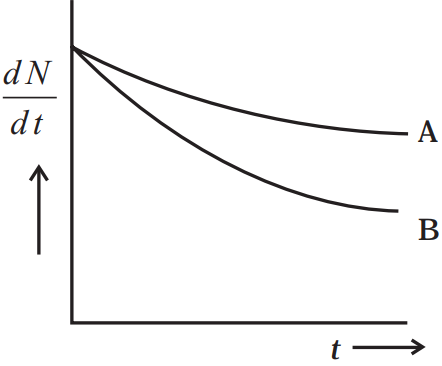
Which sample, A or B shown in Fig. has shorter mean-life?

(i) What is meant by electric power? Prove that $P=\frac{V^2}{R}$ or $P=I^2 R$. Define one-watt electric power.(ii) Define electric energy. Prove that $P = I ^2 R \Delta t$