Question
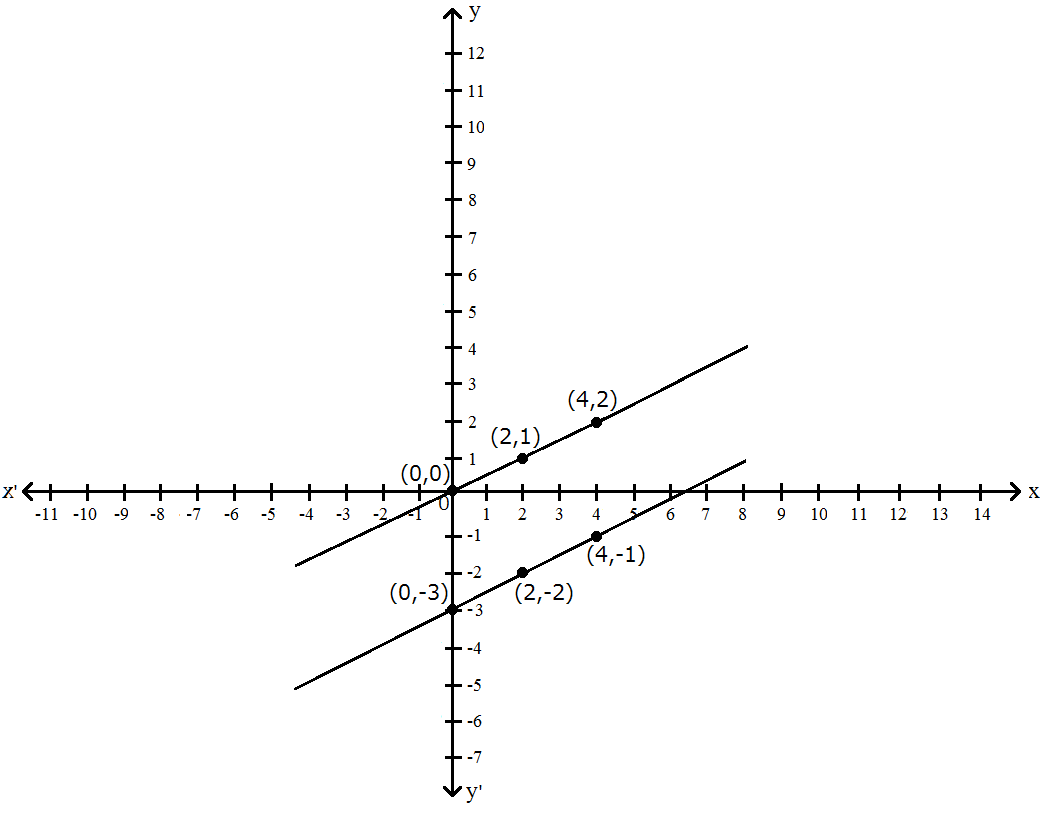
Show graphically that the following system of equation is in-consistent (i.e. has no solution):
x - 2y = 6
3x - 6y = 0

Answer

The given equations are,
x - 2y = 6 .......(i)
3x - 6y = 0 ........(ii)
From (i), $\text{y}=\frac{\text{x}-6}{2}\ ......(\text{iii})$
Putting x = 0 in (iii), we get y = -3
Putting x = 2 in (iii), we get y = -2
Putting x = 4 in (iii), we get y = -1
x
0
2
4
y
-3
-2
-1
From (ii), $\text{y}=\frac{3\text{x}}{6}\ ......(\text{iv})$
Putting x = 0 in (iv), we get y = 0
Putting x = 2 in (iii), we get y = 1
Putting x = 4 in (iii), we get y = 2
x
0
2
4
y
0
1
2

When we plot these points on graph paper we observe that both linesare parallel to each other means they have no solution so they are in-consistent.

Need a full question paper?

Generate a complete, print-ready paper with questions like this in minutes — across 16+ boards, with answer keys.

Start Generating Free

Similar questions

The horizontal distance between two towers is 60 metres. The angle of depression of the top of the first tower when seen from the top of the second tower is 30°. If the height of the second tower is 90 metres, find the height of the first tower. $\big[\text{Use}\sqrt{3}=1.732\big]$
A man is $3\frac{1}{2}$ times as old as his son. If the sum of the squares of their ages is 1325, find the ages of the father and the son.
Use remainder theorem to find the value of k, it being given that when $x^3 + 2x^2 + kx + 3$ is divided by (x - 3), then the remainder is 21.
Solve for x and y:
$\frac{5}{\text{x}+\text{1}}-\frac{2}{\text{x}-\text{1}}=\frac{1}{2}$
$\frac{10}{\text{x}+\text{1}}+\frac{2}{\text{y}-\text{1}}=\frac{5}{2}$
Find the distance between the points $\Big(\frac{-8}{5},2\Big)$ and $\Big(\frac{2}{5},2\Big).$
Determine a point which divides a line segment of length 12cm internally in the ratio 2 : 3. Also justify your construction.
A number consists of two digits. When it is divided by the sum of its digits, the quotient is 6 with no remainder. When the number is diminished by 9, the digits are reversed. Find the number.
If $\text{x}=\text{a}\sec\theta+\text{b}\tan\theta$ and $\text{y}=\text{a}\tan\theta-\text{b}\sec\theta,$ prove that $\big(\text{x}^2+\text{y}^2\big)=\big(\text{a}^2-\text{b}^2\big).$
Find the ratio in which the line segment joining the points A(3, -3) and B(-2, 7) is divided by x-axis. Also, find the point of division.